
Michigan Traffic Court Records
Check the ticket for the court name. Most Michigan traffic citations go to the District Court printed on them. Those courts hear both civil infractions and traffic misdemeanors. A traffic felony can move up to Circuit Court after bindover. Four statutory Municipal Courts also exist. They have limited local jurisdiction, so a city name alone will not tell you who holds the record.
The citation itself is your map. It lists the court and location. It shows the ticket number and response date. The clerk's official Michigan case history records every answer, hearing, payment, default, or disposition. A payment service may take an eligible citation. It may not show the full register or any filed documents.
The Michigan Department of State is a different office. It may receive a court disposition. Yet it keeps its own driver abstract and license status. For an order, balance, or hearing result, contact the issuing court.
Michigan PayTix Citation Search
Michigan District Court PayTix searches payable citations at participating courts only. It is not a full traffic-docket index. The form gives you four routes. Use last name with ticket number, last name with birth date, a driver-license number with state, or a plate with state. Pick a county and court first, since available courts depend on the county.
The Michigan District Court PayTix Ticket Search states this plainly. Only some District Courts accept online payment. Routine maintenance can interrupt the service, but an outage never extends your response date. The payment cart is blunt. Paying enters an appearance, waives a hearing, and admits responsibility.
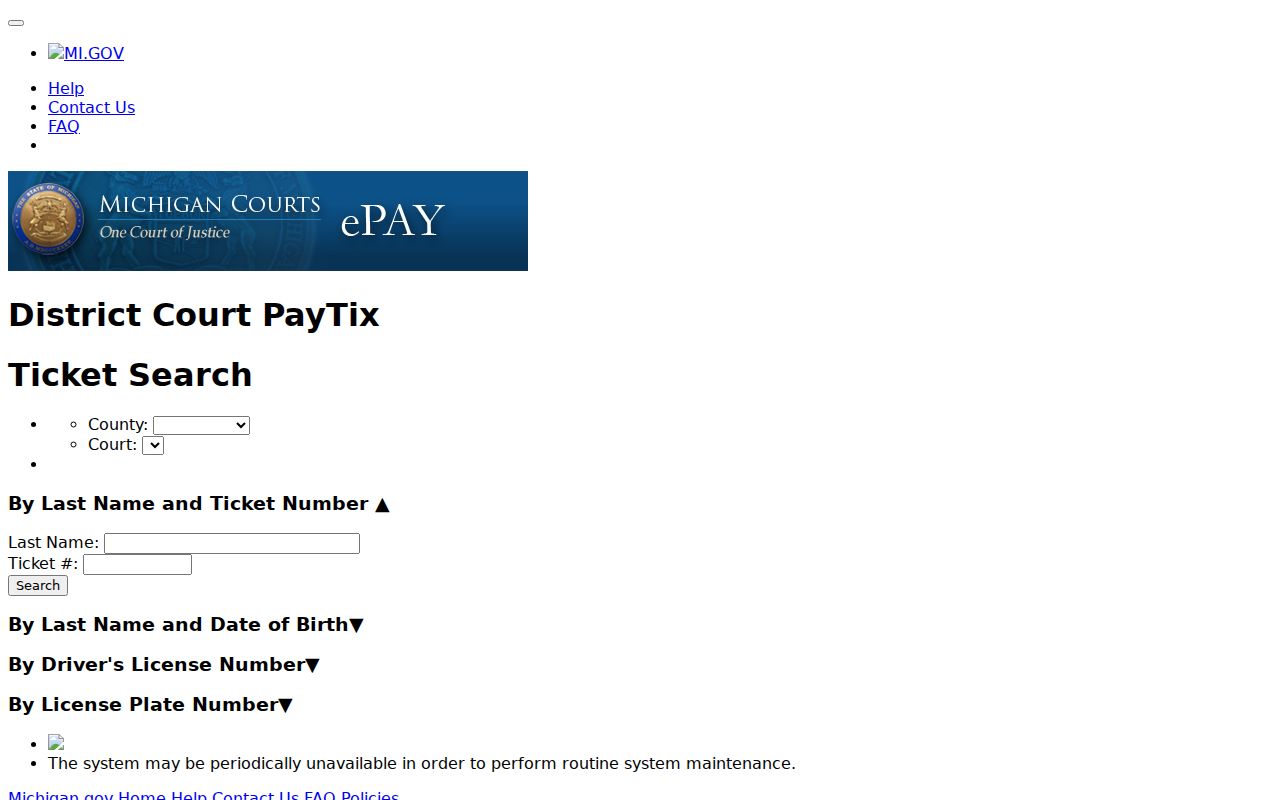
The issuing Michigan court remains the authority for the case history and response date.
Michigan Citation and License-Hold Systems
A Michigan ticket may show up in PayTix or MiCOURT, depending on the court and case type. The issuing District or Municipal Court clerk keeps the full register. The Department of State separately holds the driving record and license status.
| System or record | What it holds | Run by |
|---|---|---|
| PayTix / eCourts | Search and payment for eligible citations in participating District Courts; not a full statewide citation index. | Michigan eCourts and participating courts |
| MiCOURT Case Search | Public case summary for participating JIS courts and visible case types; not every traffic matter. | Michigan judiciary / JIS |
| Michigan local court register | Citation, hearing, response, payment, order, default, and disposition entries. | Issuing District or Municipal Court clerk |
| Michigan driver record and license status | State driving abstract, reported convictions, points, and licensing information under state rules. | Michigan Department of State |
No Michigan ticket search covers every court. A ticket missing from PayTix still exists as a local court case, and PayTix's payment roster differs from MiCOURT's search coverage. Use the citation and the county directory to identify the right court and clerk.
What Paying a Michigan Ticket Means
Michigan civil infractions give you three options: pay, admit with explanation, or request a hearing. Paying through PayTix admits responsibility and waives the hearing. It does not reserve a later contest. Follow the answer or appearance date printed on the citation. No single first-response period applies to every ticket. Each deadline stands on its own.
- Admit responsibility
- Accept a Michigan infraction and pay the amount assessed by the issuing court.
- Admit with explanation
- Accept responsibility while asking a Michigan court to hear an explanation before it sets the assessment.
- Informal hearing
- Contest a Michigan civil infraction through the informal process before a judge or hearing officer.
- Formal hearing
- Ask for the formal court hearing provided by Michigan’s civil-infraction procedure.
- Default judgment
- A Michigan court action that may follow when a person does not answer or appear as required.
MCL 257.745 and Michigan Court Rule 4.101 govern responses and hearings, setting out the rules that control both. The issuing court sets the amount and explains its process, so follow its instructions whenever online payment fails.
Looking Up a Michigan Traffic Ticket
Let the ticket be your search map. Its court name and response date beat any statewide assumption. PayTix and MiCOURT each have participation limits, and the Michigan clerk can confirm an entry and steer you to the right payment or hearing route.
- Read the Michigan court name, number or location, ticket number, and answer date on the citation.
- Try PayTix only if the issuing county and court appear in its selector; use one of the form’s available ticket or identity routes.
- Search the Michigan issuing court’s public case system, including MiCOURT where that location participates, for the register and number.
- If no result appears, call or visit the issuing court clerk using the County Directory and ask how to check the citation or request public inspection.
- Confirm the court’s current amount, deadline, and hearing instructions directly before paying or contesting.
A citation may lead to District, Municipal, or transferred Circuit Court records. A public terminal may be available under local procedures, and Michigan District Court boundaries can cross county lines.
PayTix Does Not Cover Every Michigan Ticket
The Michigan PayTix entry lists participating courts. Genesee, Gogebic, Hillsdale, Ingham, Kalamazoo, Kent, Marquette, Oakland, Washtenaw, and Wayne Counties are included, along with court locations inside them. Treat it as a payment roster, not a statewide list of courts or citations. A court left off PayTix may still help. It may run its own local case search or payment page.
Tickets go missing for several reasons. The court may not participate. The number may be typed wrong, or the file may not be posted. The court may use a local route instead. PayTix covers only some Michigan District Courts, and an outage never changes the response date.
Use the citation and the Michigan Trial Court Directory to identify the clerk. Is the court number unclear? Ask the issuing agency which Michigan court received the ticket.
Paying or Fighting a Michigan Ticket
Paying a Michigan civil infraction admits responsibility and waives a hearing. Contesting means using the response route stated on the ticket. An "admit with explanation" still accepts responsibility, unlike an informal or formal hearing request.
| Choice | What it means | Next step |
|---|---|---|
| Pay / admit Michigan ticket | Responsibility is admitted; PayTix payment waives a hearing. | Pay by the date on the citation and save the receipt. |
| Admit with explanation | Responsibility is accepted, with an opportunity to explain before assessment. | Ask the court how to submit the explanation and when to appear. |
| Informal hearing | The infraction is contested under the informal procedure. | Request the option from the court and follow its hearing notice. |
| Formal hearing | The matter is heard by a judge under the formal process. | Make the request by the stated deadline and appear as ordered. |
Do not assume an outage extends the date. Michigan eCourts says a PayTix service interruption does not extend the answer deadline. The citation or later court order controls the response date. Contact the issuing clerk promptly if a payment or hearing option is unavailable.
MCL 257.745, MCL 257.741, and Michigan Court Rule 4.101 govern the civil-infraction process from start to finish. The SCAO Michigan CIA 01 citation identifies the court, the scheduled date, and your response choices.
Michigan License Holds: Court and SOS
Michigan no longer suspends licenses over every unpaid ticket. MCL 257.321a limits license holds to designated violations and sets a statutory notice process. Most failure-to-appear suspensions tied to non-driving-safety offenses ended under reforms effective October 1, 2021. Unpaid parking holds ended under the same reforms. Clean Slate to Drive relief later cleared some older holds. That relief does not erase a conviction or a court balance.
If a hold qualifies, settle the ticket with the issuing court first. Ask the court whether it must report clearance. Then confirm your status with the Michigan Department of State. Judiciary guidance lists a $45 clearance fee. It applies to each qualifying matter. Both the court and SOS can confirm the hold and the charge. Road to Restoration clinics advise on restoration. They do not pay tickets or guarantee reinstatement.
The SOS Clean Slate to Drive FAQ answers this. It spells out which old holds were cleared and which court balances or other fees may still remain.
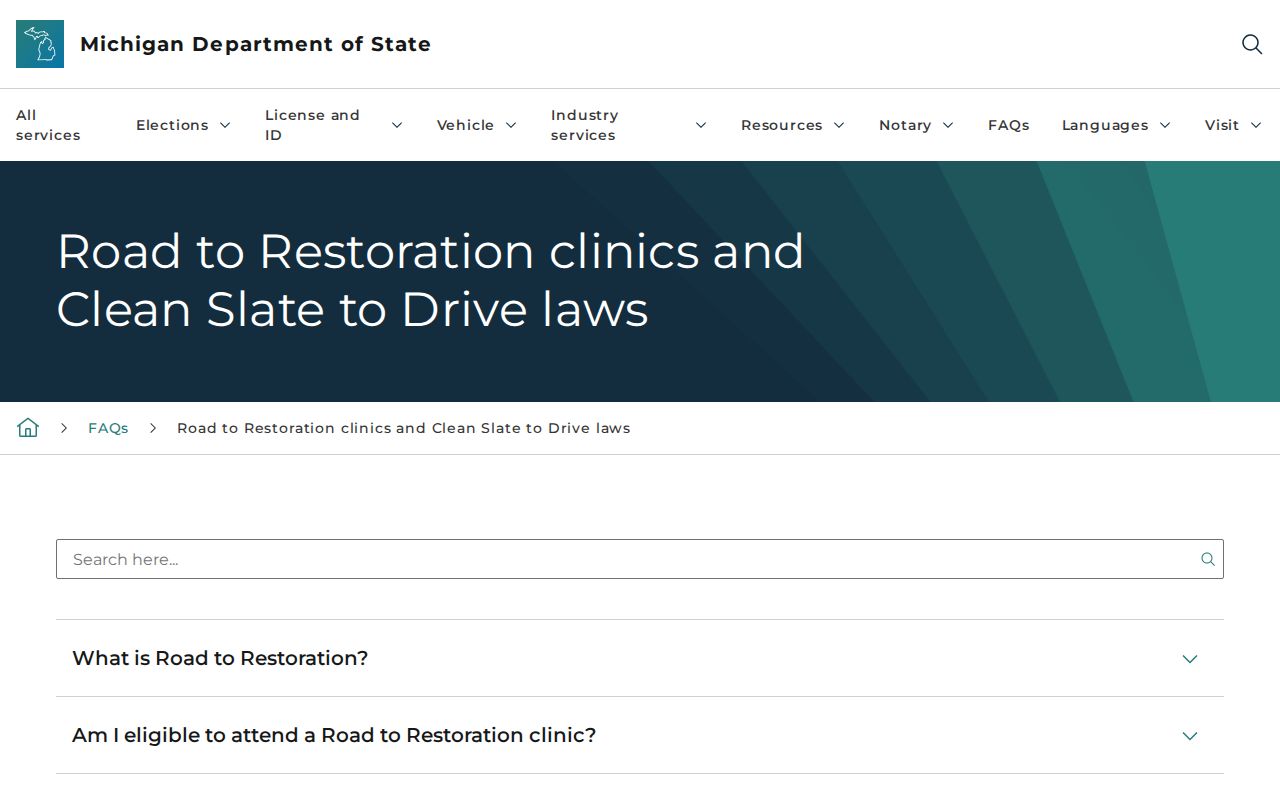
Remember that the SOS information covers a licensing record. The Michigan court clerk still holds the citation, register, payment, and final order.
Michigan Court Record vs Driver Record
One Michigan traffic citation can leave two records behind. The court file covers the citation, your response, the hearing, payment, and the outcome. Separately, the Michigan Department of State keeps the driver abstract and licensing data. Court information may flow to the state. Even so, each system has its own custodian, display rules, and update timing. Searching one does not replace requesting the other.
| Question | Michigan traffic-court record | Michigan driver record |
|---|---|---|
| Who keeps it? | Issuing District or Municipal Court clerk | Michigan Department of State |
| What does it show? | Citation, case events, hearing, order, payment, and court disposition | Driving abstract, reported convictions, points, and license information |
| How is it requested? | MiCOURT or local court portal, public terminal, or clerk request | Official SOS driver-record service with its access requirements |
| Does it clear the other file? | A court payment or order may prompt state reporting, but does not itself create an SOS abstract. | An SOS record does not provide the complete court register or signed court order. |
The Michigan SOS driver-record service handles abstract requests, including authenticated online access. The court clerk supplies citation copies, certified dispositions, and transcripts. For a case outcome, use the court file; for the current abstract and license status, use SOS.
Michigan Work-Zone Cameras Have Narrow Authority
Michigan allows only two narrow camera programs. Under MCL 257.627c and 2024 PA 164, MDOT can run work-zone enforcement on state-controlled highways in non-concrete-barrier zones. The program is subject to sign, speed-display, worker-presence, visibility, location, and system limits. Full authority began April 2, 2026. This is not general city speed or red-light enforcement.
A violation means at least 10 mph over the limit while workers are present. A first violation draws only a warning. The same is true more than three years after a prior violation. A second within three years of a warning may cost up to $150. A third or later may cost up to $300. The owner may rebut the presumption of driving. Images may be used only for adjudication. They must be destroyed once the contest or appeal period ends or the fine is paid.
School-bus stop-arm cameras run on a separate set of rules. Those rules are MCL 257.682, MCL 257.1820, 2024 PA 161, and PA 163. Law enforcement reviews the evidence, mails the citation, and makes images available for a contest. The fine runs $100–$500. These statutes are narrow exceptions, not blanket city camera authority.
On a camera citation, follow the Michigan court. Also follow the response date printed on the notice. The citation and register control the case, and a camera notice replaces neither record.
BDIC Does Not Remove a Michigan Court Record
The Michigan Basic Driver Improvement Course is open to some drivers. Those drivers must receive an SOS notice. Eligibility generally requires a valid noncommercial Michigan license. It also requires no more than two existing points, a ticket worth three or fewer points, and completion within 60 days. The course runs at least four hours, and providers may charge up to $100. The current SOS notice controls who qualifies.
Finishing BDIC may prevent points or insurance reporting under the SOS program. It does not dismiss the ticket. It also does not remove the Michigan court file, the fine, or the costs. A local safety course can affect a citation only when the court offers and accepts it. Michigan offers no general statewide deferred-disposition track.
Ask the issuing court about its program and order. Then follow the SOS instructions for course eligibility and how your driver record is treated.