
Searching Michigan Court Dockets
Every Michigan court docket search begins with one question: which court received the case? Your paperwork usually answers it. A citation, summons, order, or hearing notice names the court. It may list a court number or location. That matters in a state with separate Circuit, District, Probate, and limited Municipal Court records. The statewide case search works well as a starting index for participating courts. It cannot replace the local register or the clerk who keeps it. Move from broad search to controlling record in this order:
- Read the latest court paper and note the court, case number, case type, and county or court location.
- Search the named court in Michigan MiCOURT Case Search by party name or case number. The public search works one selected court at a time.
- If the court does not appear or the case is missing, use the Michigan Trial Court Directory to find its local search and clerk contact.
- Read the Michigan register of actions in date order. Treat a hearing row as a setting and check later entries for a reset, result, or signed order.
- Ask the Michigan court clerk for a public filing, transcript, certified copy, or current hearing confirmation when the online summary is not enough.
A felony adds a wrinkle. The District Court may hold a preliminary file while a new Circuit Court number follows bindover. Civil, estate, traffic, and misdemeanor matters can start in different courts too. Always work from the latest notice.
Michigan MiCOURT Search Fields
MiCOURT is the public case-search service for courts on the state's Judicial Information System. Pick a court first. The form then asks for a name or number. It is not one search across all 83 counties. The documented interface keeps separate panels for name and case number. Its fields make no promise of a match. That applies when a court or case type sits outside the service. The court selector is dynamic. So use the state directory to verify the current court list.
| Public field | What it accepts | Michigan search note |
|---|---|---|
| Selected Court | One Michigan court context | Choose the Michigan court named on the case paper; current options load dynamically. |
| Last Name or Business | Required text for a Michigan name search | Use the party’s last name or the legal business name if known. |
| First Name, Middle Name, Birth Year | Additional text or year fields | The Michigan public form shows these as narrowing fields; required status is not specified. |
| Case Number Year, Number, Type | Number segments and a type control | Michigan case-type choices vary by court and should not be assumed to be universal. |
The official SCAO interface report documents the public form and its selected-court workflow, though it offers no current list of selector choices. Filters, result fields, and date depth vary by court and case type. A blank result means confirm the venue. It is not a statewide finding.
Inside the Michigan Statewide Case Search
MiCOURT Case Search presents public case information for participating Judicial Information System courts. Its terms call results informational. Questions go to the court of record. The Michigan search can return case metadata and a register-style event summary, but it is not a certified register, an order, or a full copy of a case file. Michigan's trial courts hold the official record, and each explains its own access procedures.
A 2023 snapshot showed MiCOURT searching one court at a time across 187 Michigan locations. That dated figure is not a current 83-county coverage promise. A February 2026 report counts 260 of 302 trial courts using JIS case systems, a different measure from MiCOURT locations or e-filing coverage. Neither report makes every court or case type searchable in one place.
For a deeper look at court levels and data flow, see the Court System guide. The county clerk or other court-level clerk still controls the local case register, filed documents, and certified copies.
Why Michigan Cases Miss MiCOURT
A missing case in MiCOURT does not mean the case is missing in Michigan. Some courts run a non-JIS case-management system and publish a separate public search. Others drop cases for narrower reasons. The type may be confidential, the court may limit the criminal date range, or the record may predate its online service. The public terms name juvenile and child-protective proceedings, adoption, personal-protection-order matters, mental-health cases, name changes, and other protected categories that never display.
Michigan's 2023 SCAO report listed Wayne, Kent, Macomb, Ingham, and Washtenaw among large Circuit Courts on non-JIS systems at that time. Wayne Third Circuit's Odyssey Public Access notice describes local case results, registers of actions, and civil judgments. It also states that public document images are unavailable there. Oakland County runs its own Court Explorer route. One statewide no-match settles nothing.
Check the named Michigan court's own page first. Then call its clerk or inspect records at the courthouse if needed. A search can also fail for small reasons. A case number changed after transfer, a name was entered differently, a filing has not been accepted, or a restriction blocks display. The clerk can point you to the right record route without revealing what Michigan law keeps private.
Which Michigan Courts Keep Dockets
Michigan's trial courts divide the work. Circuit Court holds general jurisdiction. District Court handles most misdemeanors, traffic, small claims, and limited civil cases. Probate Court covers estates and related matters. Four statutory Municipal Courts carry limited local jurisdiction. The Court of Appeals and Supreme Court keep separate appellate dockets.
| Court | Docket covers | Where to search |
|---|---|---|
| Michigan Circuit Court | Felonies after bindover, major civil matters, family division, and District Court appeals | MiCOURT if participating; County Clerk as Circuit Court Clerk or local portal |
| Michigan District Court | Misdemeanors, preliminary felony stages, traffic, civil claims generally up to $25,000, and small claims up to $7,000 | MiCOURT if participating; District Court Clerk for its location |
| Michigan Probate Court | Estates, decedent matters, guardianships, and conservatorships, with case-specific privacy limits | MiCOURT where available; Register of Probate |
| Michigan Municipal Court | Limited matters assigned to one of four statutory local courts | The Municipal Court Clerk for the court named on the paper |
| Michigan appellate courts | Appeals, motions, oral argument, and appellate opinions or orders | Michigan appellate Cases, Opinions & Orders search and appellate clerk |
The state's January 2024 court-unit table counts 242 trial-court units across 83 counties. A county is not a one-to-one proxy for a court office. One county can hold several locations. Some districts cross county lines. Your summons, citation, or case number points to the specific court.
MiFILE Filing and Michigan Case Search
Michigan runs two separate systems for two separate jobs. MiFILE, built on the TrueFiling platform, handles electronic filing. Attorneys and other approved filers submit court papers in participating courts and case types. MiCOURT handles the other direction: the public searching cases in courts that take part. Keep the distinction in mind. A filing receipt from MiFILE only confirms submission. It does not prove the clerk accepted the filing into the official register. Even an accepted filing may lag. It may not show up as a document image in a public search right away.
The rollout is phased. The numbers can mislead. The March 2026 court matrix splits statewide MiFILE from local pilot systems. It also lists which courts, case types, and filers qualify. Its login notice says 127 trial courts are supported. That figure is not MiCOURT search coverage. Wayne, Oakland, Antrim, Grand Traverse, Leelanau, and Macomb have each shown up in separate pilot or service notices. Before relying on any platform, read the availability list and the filing court's own instructions.
Timing also differs between systems. A new Michigan filing, a case transfer, a payment change, or a reset can move slowly. The public screen may lag behind the clerk's internal system. Ask the receiving Michigan court whether a submission was accepted and when the public case history will reflect it. A filing service is not the Michigan public docket, and it is not a bulk data feed. The MiFILE / TrueFiling login and coverage notice covers filing access, and the live court list names the participating locations and case types.
What a Michigan Court Docket Shows
Michigan's court rules call this record the "case history." Other places say register of actions, or just docket. Each entry records a filing, a court event, or some other action taken in the case. The case file itself is bigger. Complaints, petitions, motions, exhibits, notices, orders, judgments, and transcripts can all sit inside it. So a short online row may name a document without containing its text.
| Case number | The identifier assigned by a Michigan court; year, sequence, and case-type code may appear in different formats. |
|---|---|
| Case type | A Michigan court category such as felony, general civil, small claims, or probate, subject to local display. |
| Filing and reopen dates | Dates the Michigan case or later reopening was entered into the system. |
| Status and disposition | Administrative state or outcome field; it may not describe every Michigan claim or charge. |
| Event history | Dated entries for Michigan filings, hearings, orders, transfers, or judgment events. |
| Court and judge | Location and assigned Michigan judicial officer when that information is public and displayed. |
The rules are explicit on the wording. The Michigan Court Rules, Chapter 8 label the register "case history (known as a register of actions)." The court keeps the official record. What you pull up online can leave out an order image, a financial field, or event detail that the local case file actually holds.
Michigan Case History and Register Terms
The vocabulary overlaps in everyday use. "Docket" survives as the familiar search term even though Michigan Court Rule 8.119 says the automated case history replaced the old docket. Searching with both "case history" and "register of actions" helps when you hunt for court instructions or an online register.
- Case history
- Michigan’s rule-defined name for chronological events entered in a trial-court case.
- Register of Actions
- The common Michigan public-facing term for the case history.
- Case file
- The broader set of pleadings, process, orders, judgments, exhibits, and related Michigan records.
- Disposition
- A Michigan court outcome or status label; check the entry and signed order to see what ended or remains pending.
- Bindover
- The transfer of a Michigan felony matter from District Court to Circuit Court after the preliminary stage.
Case-type codes describe the kind of matter, never a verdict. FH marks a Circuit Court noncapital felony category. FY is a District Court felony-stage category. SC means small claims. Michigan's statewide code publication does not explain every local event outcome. Does a short label puzzle you? Check the official order or ask the clerk.
Michigan Trial Courts by the Numbers
Numbers give a feel for scale. Michigan's 2024 court workload report counts 2,630,413 incoming trial matters. It also tallies 2,918,118 outgoing or disposed matters and 484,304 still pending at year end. Those totals measure court activity, not people. Outgoing matters can include older inventory. The raw figures will not give you a clearance rate. You can filter the dashboard by year, county, court type, and case type. Population alone will not tell you that. It cannot show which Michigan courthouse carries the most filings. The Michigan Interactive Court Data Dashboard is the official filter path for these trial-court statistics.
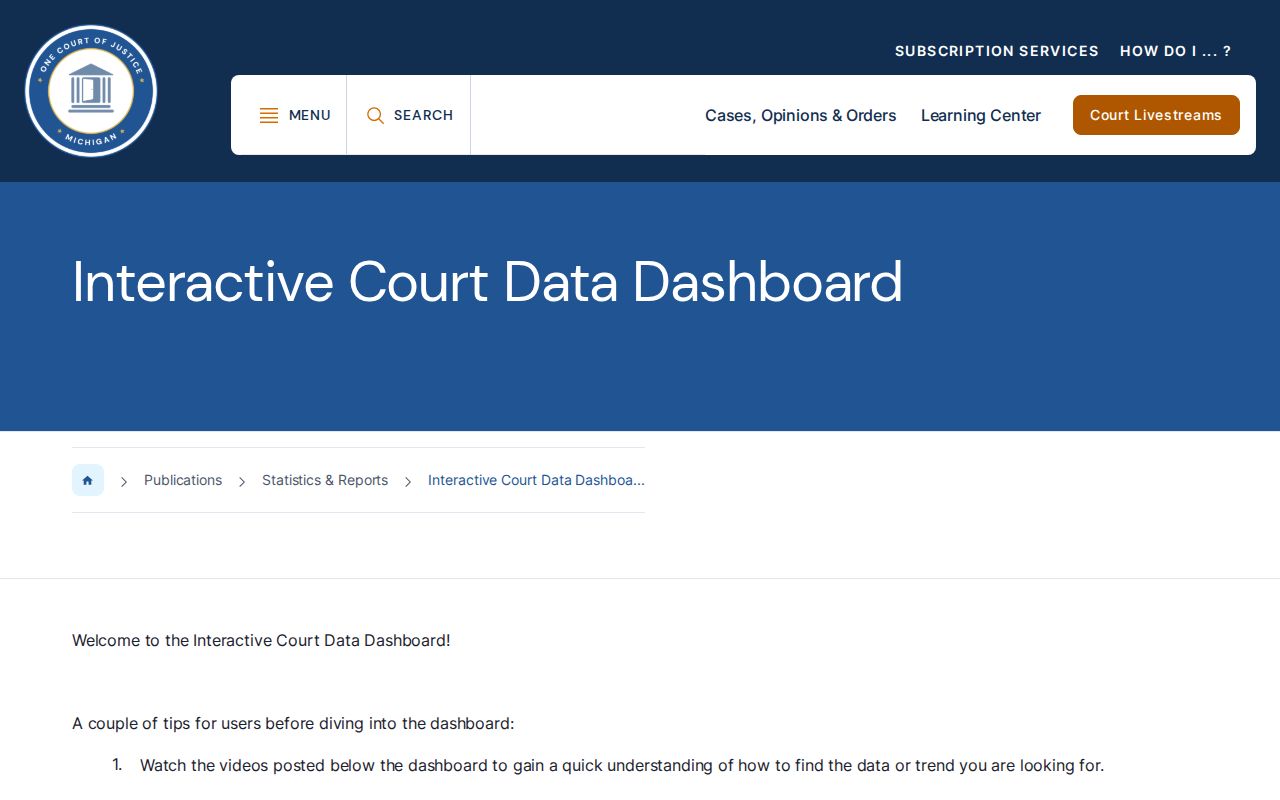
Use the dashboard for workload questions, not case lookups. It is not a docket search tool. Its totals count matters, not individual people, and they predict nothing about any one Michigan case.
Michigan Public Access to Dockets
Court rules govern access to a Michigan court case. So do local access procedures and statutes shielding particular record types. Michigan FOIA covers executive and local-government records. A clerk acting in the judicial role is different. That clerk is not treated as a FOIA public body for the court file. For a trial-court register or document, follow the court's MCR 8.119 procedure. Administrative records at the State Court Administrative Office run under a separate court rule and order.
Key Michigan access rules
MCR 8.119 defines the case history, public-access process, restriction rules, and local reproduction procedures.
MCL 15.232 excludes the judiciary from FOIA’s public-body definition while it performs judicial functions.
AO 1997-10 sets a separate route for judicial-branch administrative information, not an individual court case file.
Public status has limits online. A Michigan case can be searchable while one of its documents is sealed, redacted, or simply missing from the public portal. Not every attachment goes up. Ask the court clerk for the access procedure and for whatever record can lawfully be released.
Michigan Court Record Fees
Looking costs nothing in Michigan. Public case history can be inspected without a fee under MCR 8.119(J). Copies carry separate charges. Actual-cost rules and local orders set those rates, and no single statewide rate covers electronic retrieval, postage, archival search, or document viewers. Ask the clerk what your specific item will cost and how it will be delivered.
| Record service | Michigan statewide base |
|---|---|
| Michigan case-history inspection | No access fee under MCR 8.119(J). |
| Michigan copy or reproduction | Actual-cost principles; local court order sets the procedure and rate. |
| Michigan certified copy or exemplification | $10 plus $1 per page under MCL 600.2546 where no special fee applies. |
| Michigan court transcript | $3.75 per original page and $0.90 per copy page under MCL 600.2543, unless a lower rate is agreed. |
Certified copies start from a statutory base in MCL 600.2546, and special statutory fees may attach to certain record classes. Transcripts are different. The court reporter or recorder prepares them, with a separate price and turnaround estimate. Ask the Michigan clerk or reporter first. Get the page count, certification, postage, and any local retrieval charge before placing a large request.
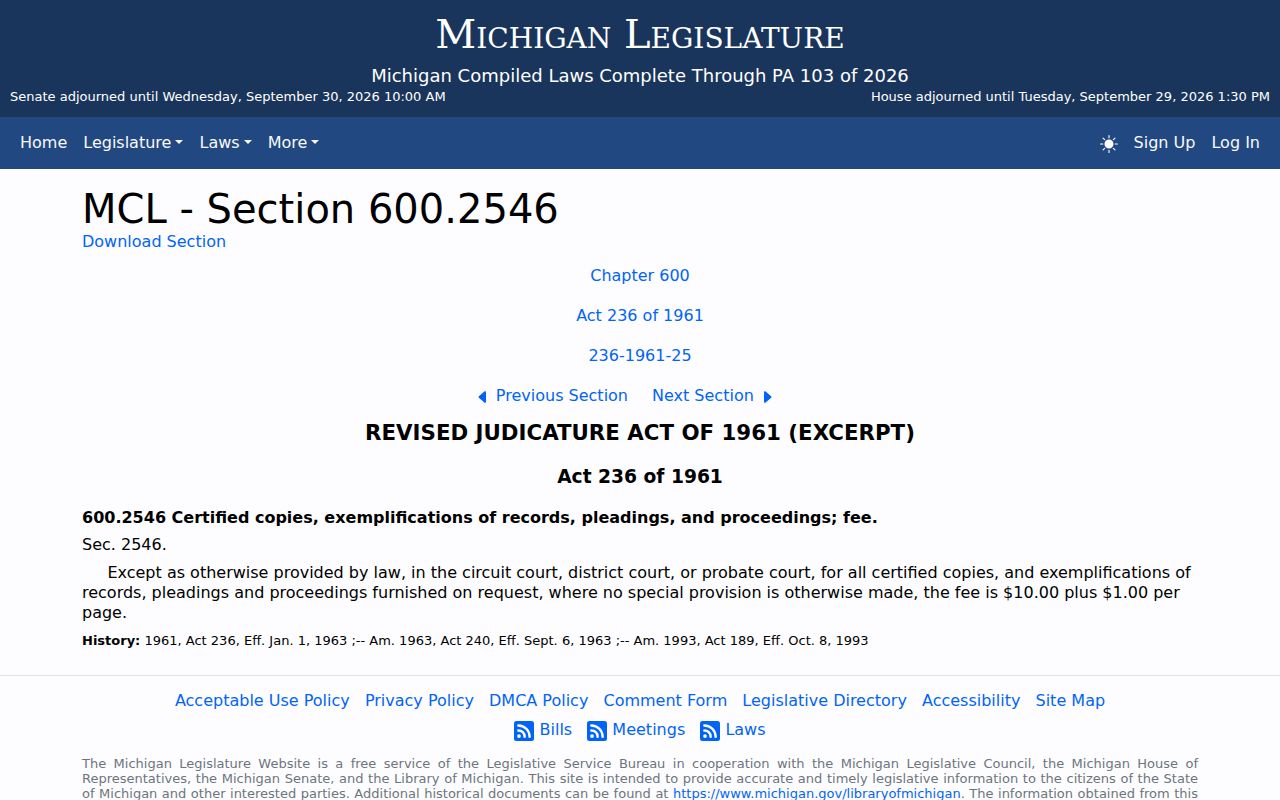
The statute image gives the statewide base only. It is not a receipt or a complete quote. Your local Michigan court sets the final amount for a copy request.
Michigan’s 1969 District Court Reform
Michigan did not always have the trial-court layout it uses now. The 1963 Constitution called for a uniform court system. Public Act 154 of 1968 made it real. On January 1, 1969, District Courts replaced the old justice-of-the-peace and circuit-court-commissioner setup. That new tier took on most misdemeanors, traffic matters, preliminary felony proceedings, and small claims. A range of other civil cases came too. It still does today.
The 1969 reform matters for anyone doing a Michigan court docket search. A felony might start in District Court. After bindover, it gets a new Circuit Court number. An appeal later opens a separate appellate docket. Each court's clerk keeps that court's own case history, so one crime can leave records in several places.
Michigan's judiciary runs a central public gateway, One Court of Justice. It connects statewide court administration, rules, and public services. The page also covers court governance and how the state system is organized. Trial-court files themselves stay with the local clerks.
The state portal can help you find court rules and public services. It cannot hand you a case file; for that, contact the clerk of the Michigan court where the case lives.
Michigan Appellate Courts Keep Separate Dockets
A Michigan appeal creates its own court record. The trial docket may show a notice of appeal. It may also show a transcript designation or a record-certification event. That is where its role ends. The Michigan Court of Appeals assigns a fresh case number. It builds its own event history. A case that reaches the Michigan Supreme Court gets yet another docket. Use the state's Cases, Opinions & Orders route to search appellate matters. Call the appellate clerk if a record is not linked online.
The Court of Appeals has four districts and hears most eligible Circuit Court appeals. Above it sits the Supreme Court, the court of last resort. Appellate calendars and filings are not substitutes for the trial register. Nor do they replace a court reporter's transcript.
Need a filing or a signed order from the trial case? Go back to the clerk of the court that created that record. A state appeal belongs in the appellate search. A federal appeal is a separate Sixth Circuit matter.
Court Dockets by County in Michigan
Michigan trial-court records sit with the clerk of the court that received the case. County is only a starting point. Circuit, District, Probate, and Municipal venues each run their own dockets. They mark population centers and regional markets rather than filing rank. Match the court number on your notice to the right local link. Then search court records there.
For geography, the official Michigan county map lays out the state's 83 county areas. The map is published by the state and reflects current county boundaries.
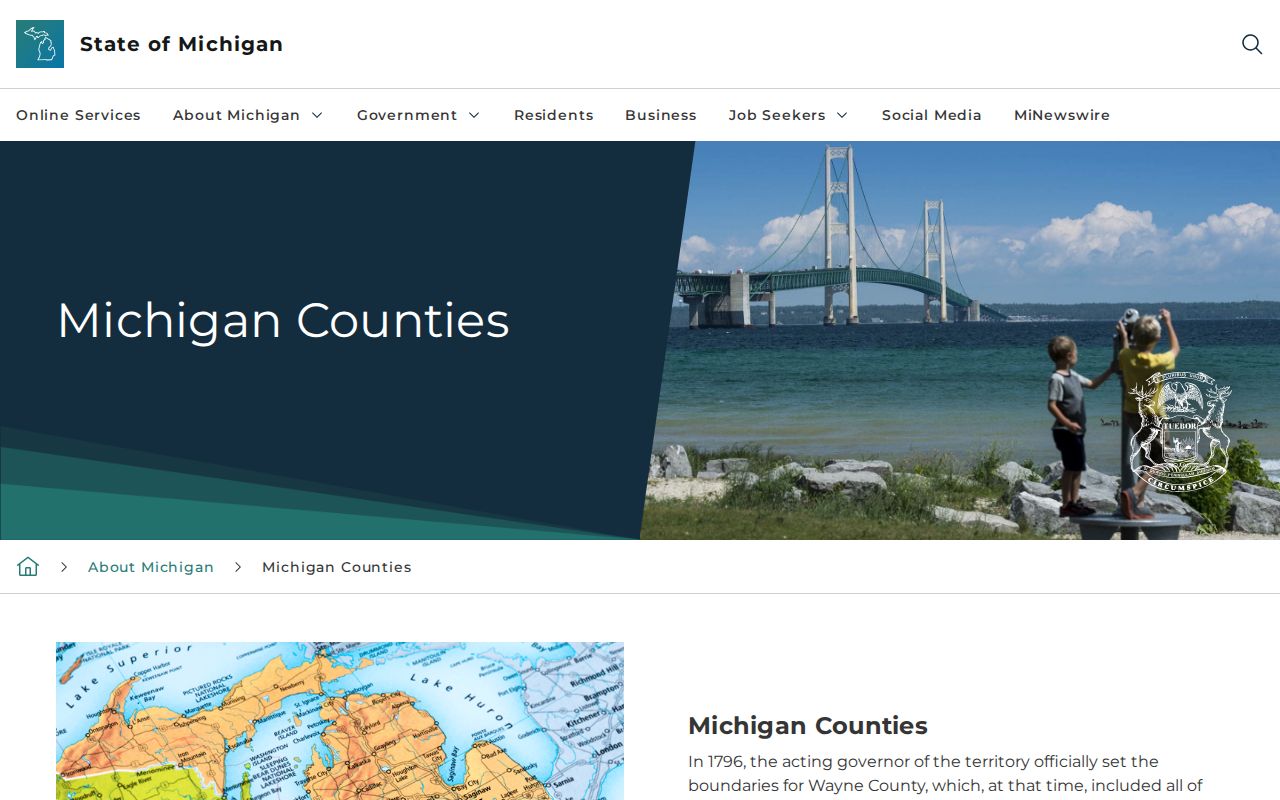
Keep in mind that the map shows county lines only. Michigan court districts can cross those lines, and a large county may hold several District Court venues, so a docket search may not follow county borders.
Wayne County
Detroit · Third Circuit uses a separate Odyssey public register search; check the court named on the case paper.
Oakland County
Pontiac · Sixth Circuit records use Court Explorer, a local route separate from MiCOURT.
Macomb County
Mount Clemens · The 16th Circuit has a separate e-filing pilot and court-specific instructions.
Kent County
Grand Rapids · Confirm the court and location because Circuit and District search routes differ.
Genesee County
Flint · The 7th Circuit appears in a 2026 expanded e-service pilot; filing access remains court-specific.
Washtenaw County
Ann Arbor · Multiple District Court venues serve the county, so use the court shown on the notice.
Ingham County
Mason · Lansing is the state capital, while county case files remain with the court clerk.
Browse the County Directory to reach the local court docket site for any of Michigan's 83 counties.