
Getting Court Records in Michigan
Start with whatever paperwork you have. The citation, complaint, or order names the Michigan court you need. No single state office hands out every trial-court file. The court itself is your destination. The County Clerk serves as Circuit Court Clerk. District Court Clerks hold district records, and the Register of Probate keeps probate files. MiCOURT can locate a participating court's public case history. Just remember it is not the official file. It also skips some courts, case types, and document images.
- Search the Michigan court listed on the notice in MiCOURT Case Search, or use the local court portal when that court has its own system. Select a Michigan court and note the case number and latest public event.
- Confirm the record custodian through the Michigan Trial Court Directory. A county can contain multiple Michigan court locations, and some court districts serve more than one county.
- For the register or a filed document, follow the court’s local online, public-terminal or clerk-counter procedure. Phone the relevant clerk if the portal lacks the case or document.
- For a copy, use the local form or written instructions and specify plain, certified or exemplified format. Mail, email, fax, drop-box and electronic delivery options vary; there is no Michigan statewide trial-court request form.
- Ask the clerk for a current quote and delivery estimate. If you need an authenticated court record, identify the specific filing or order and request certification from the clerk that holds it.
Start with the County Directory. It reaches the local Michigan court site for the docket you need. Some cases need a phone call instead. A matter may be old, transferred, or missing from a docket search. The clerk can tell you which register holds it and where the file lives now.
Viewing a file and getting copies are two separate steps in Michigan. A case summary online does not promise downloadable papers. Plan on asking the clerk what the docket entry actually contains.
Before making a request, use the Trial Court Directory selector. It routes you by court and by county. The county name alone may not point you to the right records office for the case.
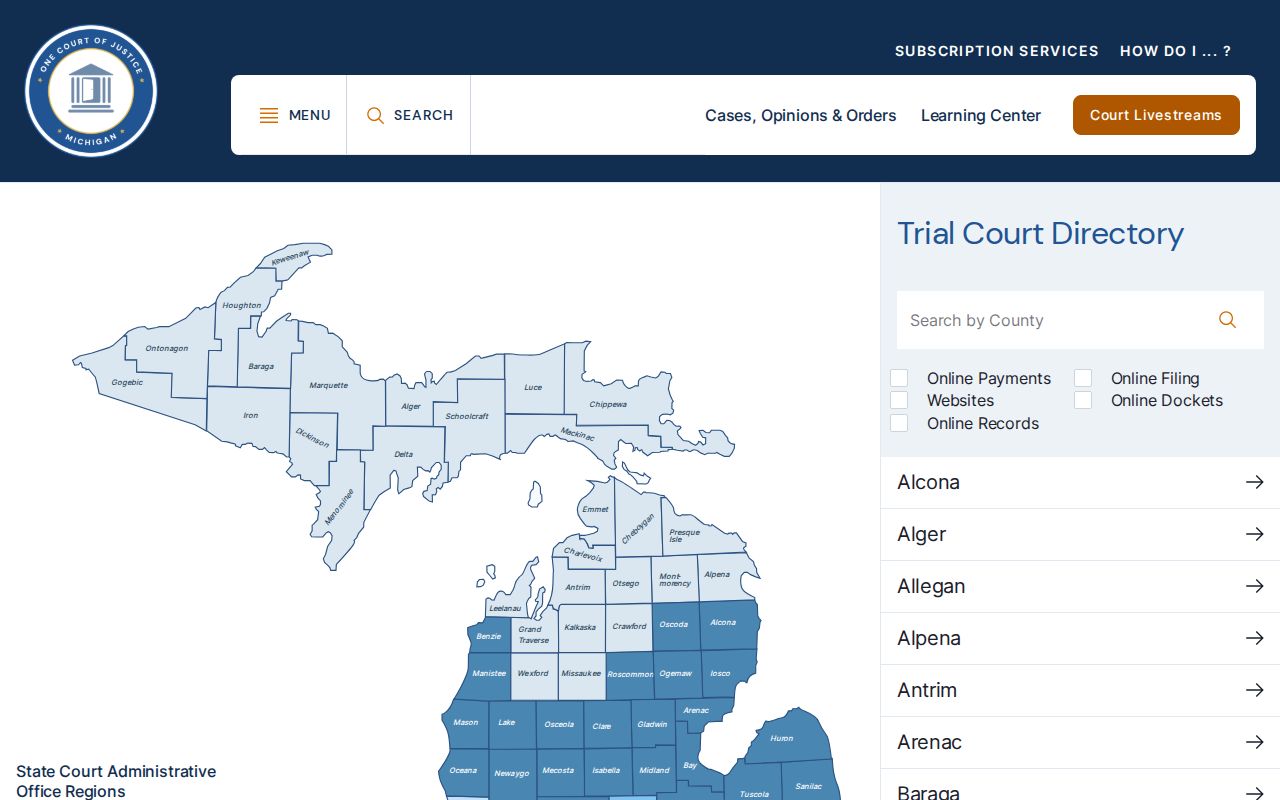
Think of this Michigan directory as a routing aid rather than a statewide records warehouse. Once you know the court, its clerk decides how inspection, copies, and delivery work.
Michigan Court Copy Request Details
Every Michigan court sets its own access and copying rules. There is no uniform statewide fillable form for trial-court records. Give the clerk enough detail to find the material fast. Pull the court and division straight from the case paperwork. Add the case number if you have it. No number? Offer a party name or case style. Then ask whether the clerk can search by name or date. Do not assume one state form or a statewide search-fee schedule applies anywhere.
| Request detail | What to specify | Why it helps |
|---|---|---|
| Court and case | Court, division, case number and case style if known | Michigan has separate circuit, district, probate, municipal and appellate records. |
| Record sought | Document title, event or hearing date | A specific order or filing is easier to locate than a request for an undefined file. |
| Copy form | Plain, certified or exemplified copy | Certification and reproduction have different charges and purposes. |
| Delivery and contact | Pickup, mail or an electronic method offered locally; contact details | The clerk can confirm availability, price, postage and timing. |
These identifiers are practical helps, not mandatory statewide fields. Local Michigan instructions govern payment and delivery. Order transcripts from the court reporter or recorder with the proceeding date in hand, and request SCAO administrative material under AO 1997-10, separate from any case file.
Types of Michigan Court Records
In Michigan, "court record" can mean three different things. It might be the register, a filed paper, or a transcript or exhibit held elsewhere. Circuit Court files include felonies after bindover. They also hold major civil and family matters, and District Court appeals. District Court records cover most misdemeanors, traffic cases, and civil infractions. Preliminary felony proceedings and small claims sit there too. Registers of Probate and Municipal Court clerks keep their own separate Michigan records.
| Record | Usual custodian | Access route |
|---|---|---|
| Case history / register | Court clerk | MiCOURT in Michigan, local portal, terminal or clerk under MCR 8.119. |
| Pleadings, orders, judgments | Case-file clerk | Portal images if offered; otherwise request a copy. |
| Transcript or exhibit | Reporter, recorder or court custodian | Order separately; retention and per-page rates may apply. |
| Appeal file | Appellate clerk | Separate appellate number, filings and opinions. |
| Federal or archived file | Federal clerk or current records custodian | PACER for federal cases; ask locally about retention and microfilm. |
Appeals get their own case number and event history. That is why the Michigan appellate Cases, Opinions & Orders search stands apart from the trial-court dockets.
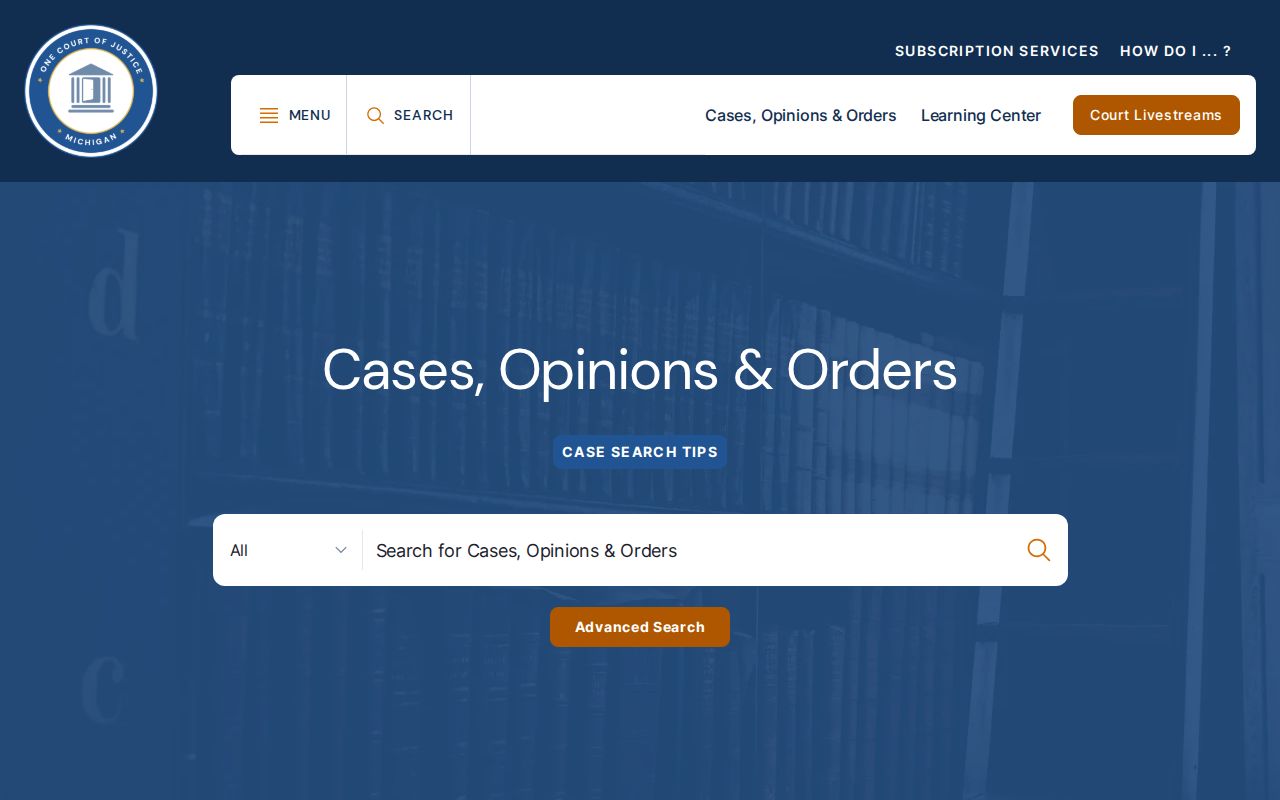
The Michigan appellate search is the right tool for a public appellate docket or opinion. Need a trial exhibit, the underlying order, or a certified county-court copy? Go back to the clerk holding that file. Federal district, bankruptcy, or appellate matters in Michigan are different. They run through the separate PACER Case Locator instead. Michigan county clerks cannot certify those federal files.
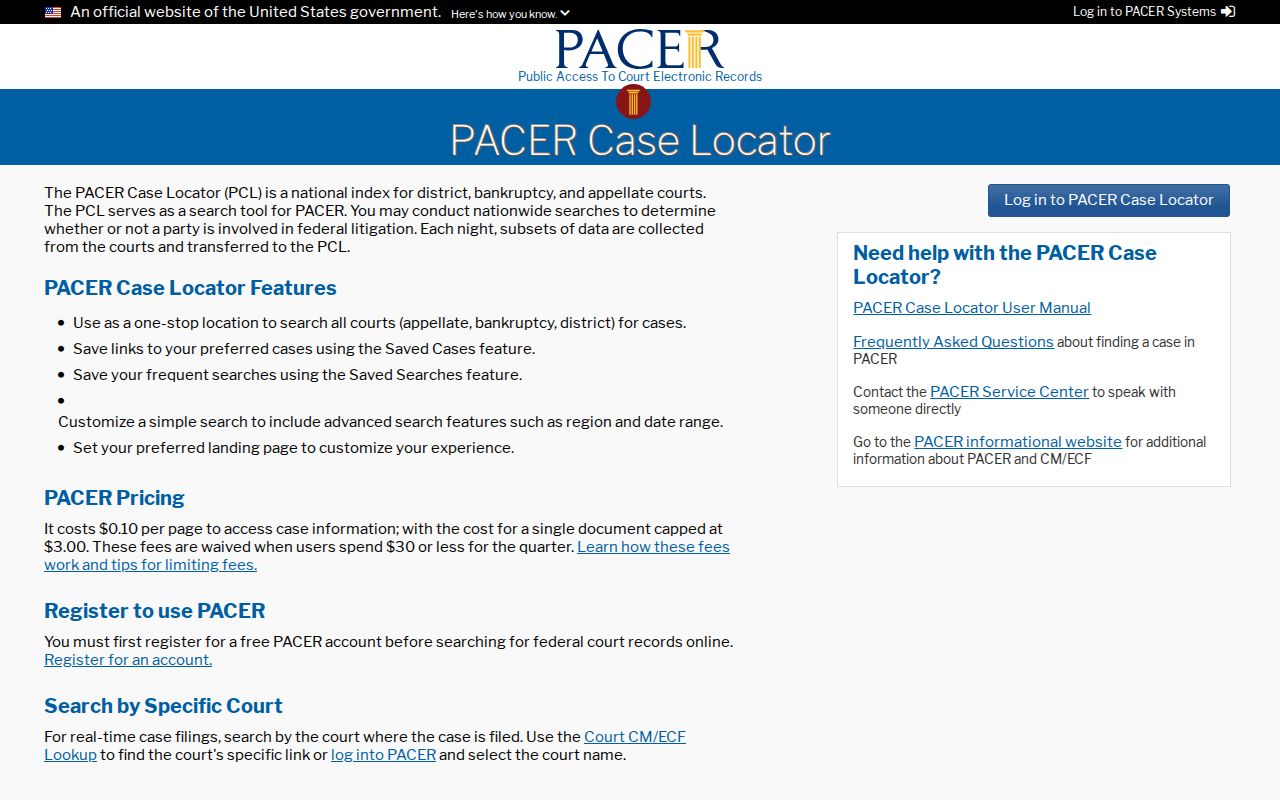
Federal access carries its own cost. Under current PACER pricing, retrieval runs $0.10 per page, capped at $3 per document, and quarterly charges of $30 or less are waived. That fee never applies to inspecting Michigan state-court records.
MCR 8.119 for Michigan Court Files
Do not route a judicial case file request through Michigan FOIA. MCL 15.232(h)(iv) leaves the Michigan judiciary out of the "public body" definition during judicial functions. That includes a County Clerk acting as Circuit Court Clerk. Ask the court itself, under MCR 8.119 and its local procedure. FOIA still works for separate executive-agency or law-enforcement records tied to the same matter. SCAO administrative records follow AO 1997-10. The office need not create a record just because you ask. For any Michigan court document, contact the clerk who holds the file.
Inside a Michigan Court Record
Michigan's "register of actions" is the chronological case history that MCR 8.119 requires. The case file holds the actual papers. A motion title or order date in a docket search does not mean the full filing, signed order, or exhibit is online. The Michigan court keeps the official record.
| Case number | Identifier for one Michigan court proceeding; bindover or appeal may produce a new number. |
|---|---|
| Case history | Dated Michigan filings, hearings, orders, disposition and transfer events. |
| Pleadings and motions | Complaints, answers and submissions; online images depend on local access and restrictions. |
| Orders and judgments | Filed decisions; request the signed document when an official copy is needed. |
| Other materials | Transcripts, exhibits and service records may have separate custodians or retention limits. |
Name the document and the date whenever you can. Michigan's local portals vary widely, and older files may sit in storage, county archives, or on microfilm, so ask the current clerk about transfers and retention.
Wayne Odyssey Registers, Not Images
Michigan's larger counties run their own case systems. Wayne County Third Circuit uses an Odyssey service. It shows local public case information, registers of actions and civil judgments. It offers no online copies of the documents themselves. Oakland County takes a different route with Court Explorer. Neither county's setup controls statewide policy.
The Wayne Third Circuit Odyssey site shows how a register works without document images. You can identify the filing in the docket. Then ask the Michigan court how to inspect or copy the paper.
When a statewide Michigan result is missing, first confirm the court and date range. Ask the clerk about paper files or restrictions. Local portal charges also differ from the statewide rule that public case-history inspection is free.
Michigan Certified Copies and Fees
A plain copy just reproduces a page. A certified copy carries the clerk's attestation, which is what most agencies want. Know the exact filing and court before you order. Michigan's default fee comes from MCL 600.2546: $10 plus $1 per page for certification or exemplification in Circuit, District and Probate Court. That applies where no special fee applies. Check with the clerk for special categories, postage, or archive retrieval costs.
| Request | State rule or base | What to confirm locally |
|---|---|---|
| Inspect public case history or document | No fee under Michigan Court Rule 8.119(J) | Counter or terminal procedure; reproduction is a separate charge. |
| Plain reproduction | Actual labor, supplies and system use under MCR 8.119(J) of the Michigan Court Rules and MCL 600.1988 | Local administrative order, page or electronic rate, postage and retrieval. |
| Certified / exemplified copy | $10 plus $1 per page under MCL 600.2546 if no special fee applies | Number of pages and any special statutory rule. |
| Transcript | Michigan transcript charges under MCL 600.2543 are $3.75 per original page and $0.90 per copy page, unless a lower rate is agreed | Reporter’s estimate, format, permitted additional charges and turnaround. |
| Federal PACER document | Separate federal retrieval pricing | Applicable federal clerk and current PACER billing terms. |
MCL 600.2546 sets the base charge; ask the clerk for the page count and total.
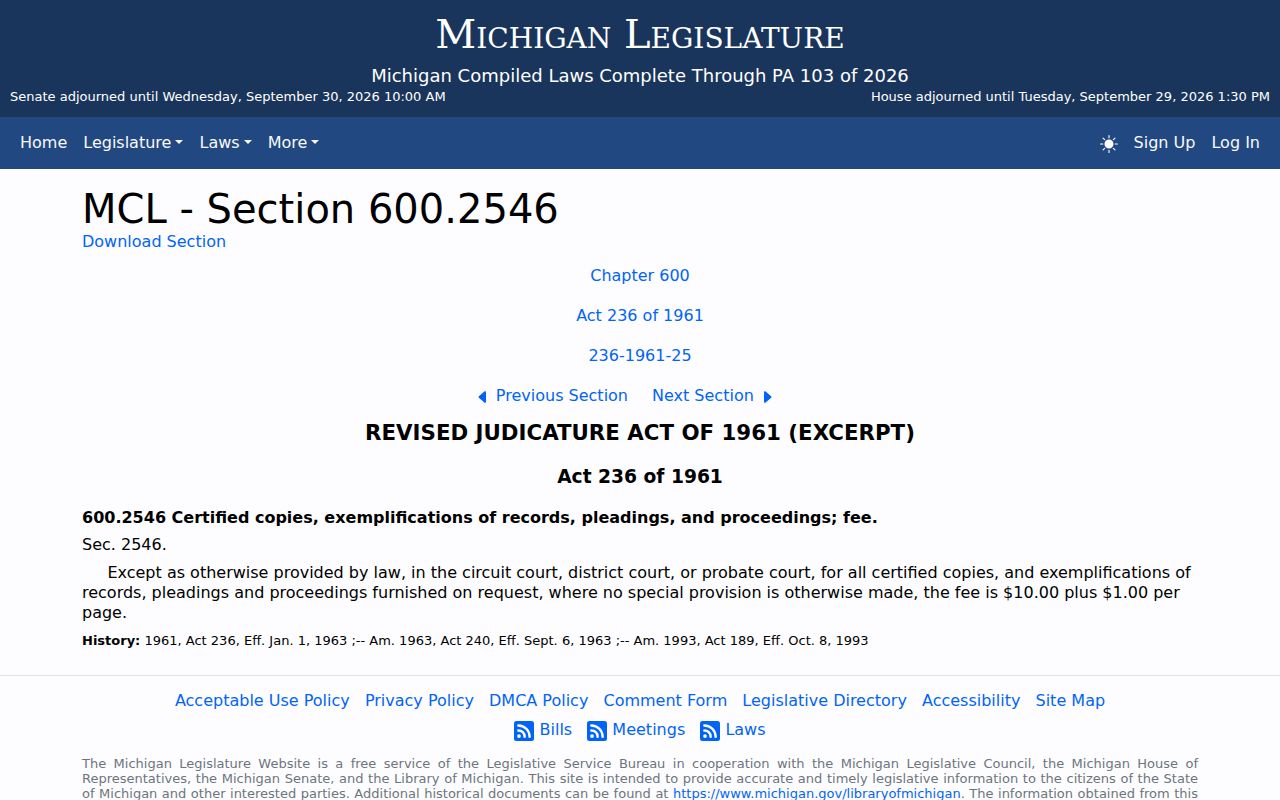
Michigan sets no single trial-court copy price or general search fee. Local orders govern reproduction, and transcript and filing charges sit apart from docket inspection.
Michigan Court Inspection and Copy Fees
Inspection is free. MCR 8.119(J) lets anyone retrieve or inspect a public court record at no charge. Its public case history is free too. Copies are another matter. Reproduction, certification, transcripts, postage, or archive retrieval can carry a cost. That cost sits under a statute and local order. Note that a portal account or filing payment is not an inspection fee.
Ask the Michigan clerk for a page estimate before ordering copies. For a transcript quote, contact a Michigan court reporter or recorder.
Sealed Court Records in Michigan
Michigan's public access rules carve out exceptions. A case can be visible while some of its documents are sealed or redacted, and confidential matters like juvenile, adoption and mental-health cases may never appear in a public docket search. One caution: a missing result does not prove a file does not exist. Ask the clerk which rule applies to that case.
Key Michigan Rules:
Michigan Court Rule 8.119 governs public case history, access exclusions, sealing and local procedure.
Michigan Court Rule 1.109 requires redaction of defined personal identifiers in filings.
MCL 780.621 et seq. governs setting aside eligible convictions and their public visibility.
Michigan's sealing rule is MCR 8.119(I). It demands a written motion plus good-cause findings that name a protected interest and weigh narrower alternatives, and opinions and orders cannot be sealed under it. Redaction under MCR 1.109 works differently: identifiers come out while the case stays public.
Michigan Cases Can Have Restricted Documents
A docket entry can be public in Michigan. The paper behind it may stay withheld or redacted. Juvenile, child-protection, adoption, mental-health, and personal-protection matters sit outside the open file. A judge's order can limit access too.
Some MiCOURT courts flag a seven-year filter on criminal sentences. That is a local setting, not a statewide age limit on court records. MCR 8.119(H)(10) can also shift public access after a felony bindover or remand.
When a document is missing, give the clerk the case number and name the paper you want. Ask whether restriction, transfer, or retention explains the gap. Then use the County Directory to find the responsible Michigan trial court.