
Court Calendars in Michigan
A Michigan court calendar is a schedule. It lists matters set for a stated time and place. Michigan Court Rule 8.119 draws a clear line between that schedule and the case history. The case history, or Register of Actions, records events as they happen. A clerk may keep the calendar in a separate file. So a row on the schedule is not the same thing as a filed notice or order, and you should not treat it as one.
No Michigan public trial calendar covers every court, judge, location, and case type at once. Some MiCOURT courts open their schedules through Court Display. Others post local calendars on their own sites. Still others simply answer questions through a clerk or court coordinator. Searching MiCOURT does not substitute for the originating court's own schedule. Rely on your notice and the County Directory to reach the right local court.
Michigan Court Calendars Are Court-Specific
A "no calendar found" message is not proof that no hearing exists. Michigan Court Display only shows the courts that opted in. Other courts post judge calendars on their own pages. Some keep courthouse lists at the front counter. Others expect you to confirm through the clerk. District Court locations can serve more than one county, so the court number and its location often matter more than a county name.
A public Michigan calendar can also leave out confidential matters. It may cover a narrow date range. It can even run behind after a change. Check the Trial Court Directory for the court's site and contact details. Compare the exact court and case number before you count on any schedule row.
| Calendar Route | Michigan Scope | Next Check |
|---|---|---|
| MiCOURT Court Display | Participating Michigan court and selected date | Confirm the Michigan court location and case number |
| Michigan local court calendar | One court, judge, or courtroom schedule | Check the court site for its current list |
| Michigan clerk or courthouse list | Local confirmation or day-of schedule | Ask the court about a recent change |
Note: Michigan’s court number and location can identify the right schedule when a county contains multiple trial-court venues.
Finding a Michigan Court Date
Start with the newest Michigan citation, summons, order, or hearing notice. It names the court and often gives a case number, date, time, and location. From there, search that court's own calendar or case history. MiCOURT covers participating courts. Local dockets and the clerk fill the gap where no statewide calendar exists.
- Read the latest Michigan notice for the court number, location, case number, date, and time.
- For a participating Michigan court, check MiCOURT Case Search and select that court; it is not a combined trial calendar.
- Open the Michigan local online docket or calendar through the County Directory.
- Ask at the Michigan clerk’s counter or public terminal how to inspect the public case history; check the courthouse’s posted daily calendar.
- Call the Michigan clerk or court coordinator to confirm a missing, old, or recently changed date and courtroom.
- For Michigan appellate arguments, use the Court of Appeals case-call or Supreme Court session calendar.
If the Michigan register, notice, and calendar disagree, ask the clerk which order is newest. A missing online row does not mean the hearing was canceled.
MiCOURT Court Display Dates in Michigan
Michigan's MiCOURT Court Display offers a public, court-specific date view where courts provide one. Pick a Michigan court and a date. The controls and the table or card layouts vary by court. A typical listing shows the party, time, hearing information, case number, and CTN. Michigan has no single statewide date range or a complete public roster of participating locations.
A separate developer calendar API exists for Michigan. Its documentation lists filters for action and case type. It also covers courtroom, a public indicator, judge or prosecutor identifiers, and date or time range. Those are integration fields for authorized developers. They are not promises about what the public calendar page will offer.
The MiCOURT calendar API documentation spells out those developer filters. That reference page describes the API behind Michigan schedules, not the public hearing-search screen.
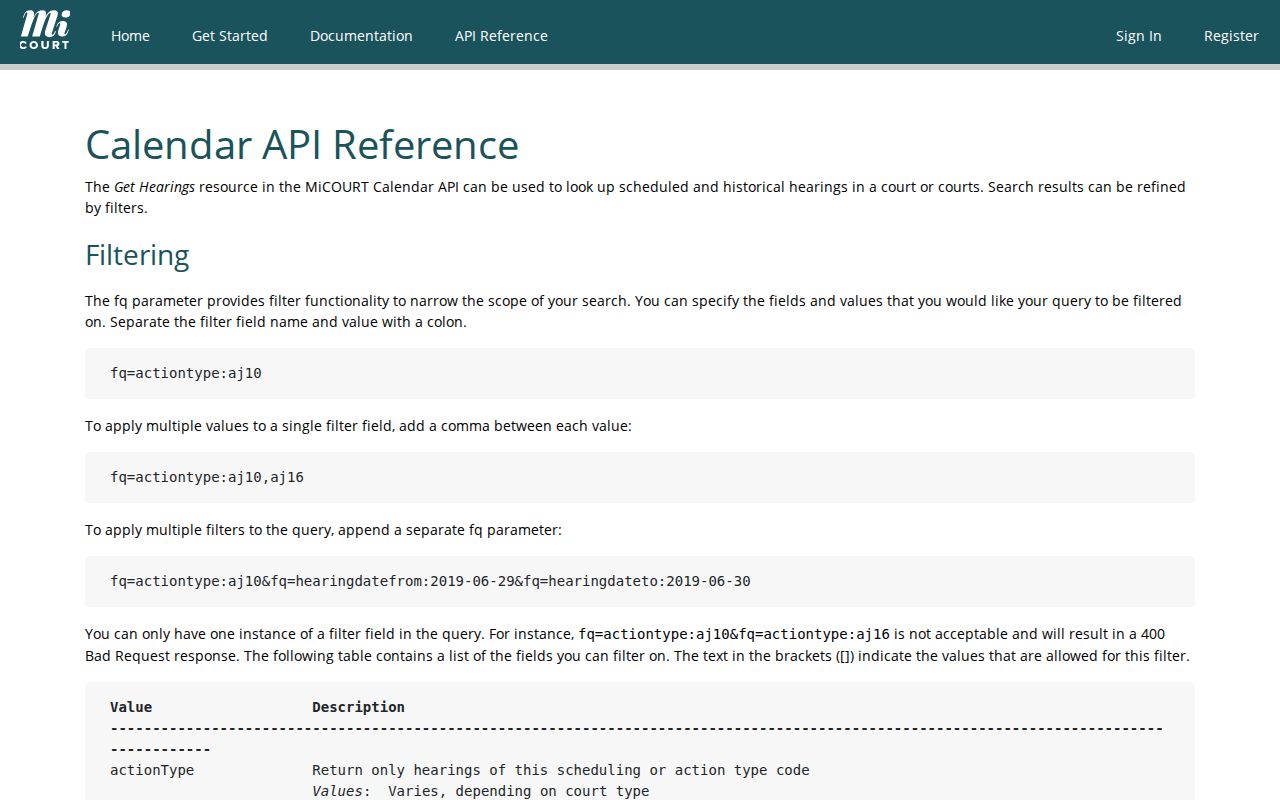
Use a public Michigan calendar or a local court schedule for a real hearing date, and confirm any doubt with the court. API fields do not mean every court shares one interface.
Note: API documentation describes developer access and must not be read as a complete public calendar or a current hearing confirmation.
Reading a Michigan Court Setting
A Michigan setting ties one event to a court, case, time, and place. Labels differ from court to court, and confidentiality rules can hide names or case-type details. The case history records activity. The calendar is the working schedule.
| Case Number | Connects the setting to a court file. Match it to the number on the latest notice. |
|---|---|
| Setting Date & Time | The scheduled date and start time shown by the local calendar or notice. |
| Court & Courtroom | Identifies the court location and, when displayed, the courtroom or judge assignment. |
| Hearing Type | Names the planned action, such as a pretrial, motion hearing, review, or trial. |
| Setting Status | May indicate that an event was set, reset, adjourned, or canceled; confirm the latest entry. |
"Conference," "review," and "motion" tell you what action is set, not how it turned out. The later order or case-history entry carries the result. If a calendar label is unclear, ask the clerk.
Michigan calendars may list arraignment, probable-cause conference, preliminary examination, pretrial, plea, settlement conference, motion hearing, trial, sentencing, review, show-cause, status conference, mediation, or jury selection. Treat these as examples rather than a statewide code list. A hearing title shows what is scheduled. The order or result entry that follows shows what actually happened.
Michigan Register vs Daily Calendar
Michigan's Register of Actions records case events in time order. A court calendar lists the matters expected at a given time and place. The register may point to a next hearing. The daily schedule shows only the date you picked. Neither one can replace the other.
| Source | What It Helps Confirm | Limit to Keep in Mind |
|---|---|---|
| Notice, citation, or order | Original date, place, and required response | A later order may change the schedule |
| Register of Actions / case history | Case-linked events and recorded changes | Recent local calendar changes may not appear at once |
| Michigan public court calendar | Matters listed for a court and date | May omit restricted matters or older events |
| Clerk or court coordinator | Current local setting and courtroom details | Contact the office for the exact court listed on the notice |
Before a near-term Michigan appearance, compare the register with the current calendar, and call the court if they conflict. A filed notice or order is what directs the parties.
Note: A public calendar is a schedule snapshot, while the Register of Actions preserves the case’s chronological event history.
Michigan Resets and Continuances
Michigan entries use words like reset, adjourned, continued, rescheduled, canceled, or removed. Each one changes a scheduled event. None of them means the case ended. Look for a later date, an order, or a clerk entry. Do not trust an old calendar row.
A daily list may be updated or thrown out once it is stale. An old PDF can linger online. If a recent filing, transfer, or reset is missing, call the court. There is no universal public refresh promise. Use the County Directory to reach the local clerk for the register or the order.
Michigan Calendar Privacy for Restricted Matters
Michigan's July 2025 Trial Court Records Management Standards set clear limits. They govern what a public calendar may show. Hearing type, courtroom, and time are fine. Names usually appear too, unless the matter is confidential. In confidential settings, the standard calls for the word "hearing" plus a case number. The case-type code is left off.
Clerks keep calendar copies for at least one year. After that, a public-use calendar can be discarded once it stops being useful. Access rests on MCR 8.119 plus any statute or court order that applies. So when a docket row looks bare, privacy rules may be the reason. The search itself is not failing.
- Case history
- Chronological activity, also called the Register of Actions.
- Calendar
- Schedule of matters set for a time and place.
- Confidential entry
- May show “hearing” and a case number without case type.
- Calendar copy
- Retained by the clerk for at least one year.
Note: Michigan calendars can limit case details when confidentiality rules apply, even when a public case number remains visible.
Missing a Michigan Court Date
Missed a Michigan court date? Call the issuing court right away. Ask if the hearing went forward. Ask whether an order issued or a new date was set, and how to view the current case history. Keep the case number and the missed date handy when you call. What happens next depends on the court's order. It also depends on the type of case on the docket.
A failure to appear in a Michigan criminal matter can bring a warrant. It can bring another order as well. Civil cases may end in a default. A traffic civil infraction can produce a default judgment. None of these results is automatic, though. Not every unpaid ticket leads to a license hold. Ask the court what the register shows now and which date controls.
If You Missed a Setting:
Call the court named on your notice for the current status and any new setting.
Ask whether an order, warrant, or default followed the missed event.
Follow the clerk’s instructions; the court confirms what applies.
Michigan Court of Appeals Calendars Are Separate
An appeal in Michigan gets its own case number and its own event history. The trial court's register may note the notice of appeal and the transfer of the record. The appellate docket, though, carries the filings, motions, arguments, and final disposition. Court of Appeals case calls and Supreme Court sessions sit apart from trial settings entirely.
For an argument date, use Michigan's appellate search and the published calendar. Unclear entries? Contact that court's clerk. Want the original trial date? Go back to the Michigan court where the case started. A Case Lookup covers the trial side but does not replace the separate appellate schedule.