
Searching Civil Dockets in Michigan
First, read the summons, complaint, or latest order and note the court and its location. Michigan’s MiCOURT Case Search then lets you query one selected court at a time. You can search by party or business name, or by case number. Not every case type shows up. Some civil and family categories stay off the results. A summary may appear without links to the filed papers. So treat a Michigan civil docket search as a starting index. It is not a promise that everything is online.
Before you type anything, write down the court number, location, parties, and case number. Michigan’s name form demands a last name or business name. A first name, middle name, or birth year can narrow things where offered. A Michigan case-number search works best when you copy the year, sequence, and court type code exactly as they appear on the file. One more caution: a county alone may not pin down the right court. Some District Courts span several counties. A single county can hold multiple court locations plus separate Circuit or Probate records.
- Confirm the court named on the complaint, summons, or order.
- Select that location in MiCOURT and search by party name or case number.
- Compare the court, case type, status, filing date, and latest event in the result.
- If no result appears or the summary is incomplete, use the County Directory to find the local court system and clerk.
- Request the specific public filing, judgment, or certified copy from the custodian.
Choosing a Michigan Civil Court Search
MiCOURT won't cover every Michigan civil docket. What you can search depends on the court you pick. The public terms list civil and probate as categories that may show up, but adoption, juvenile, personal protection order, and mental-health cases stay sealed off. When a case isn't in MiCOURT, the local Circuit or District system is the fallback. The Michigan Trial Court Directory confirms the court number. It also confirms the location printed on your filed paperwork.
The court selector is dynamic. Its public form lets you search by name, business, or case number. The filters shift from court to court. MiFILE is Michigan's e-filing service for participating courts and case types, so it handles filings rather than public civil searches. One caution on summaries: a docket entry may name a complaint or an order. It may never show the document itself. For inspection, terminal access, or copies, ask the local clerk what options exist.
To match a civil case to the right local search route, use the state directory's court links and contact details.
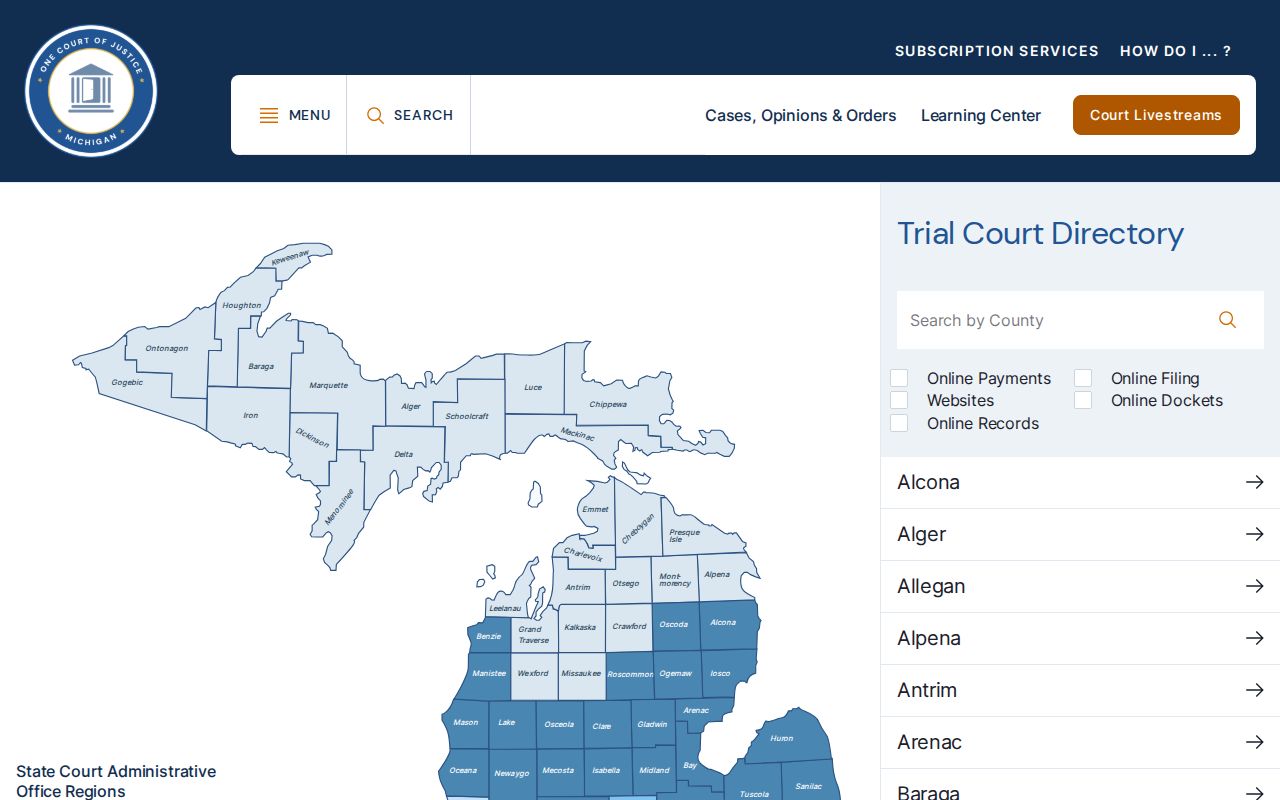
Sort out the Michigan location first. Circuit, District, and Probate records sit apart, so know which one you need before contacting the custodian for the full case history.
What a Michigan Civil Docket Shows
Michigan Rule 8.119 calls the chronological activity record the case history. Courts often display it as a Register of Actions. It lists filings, process, hearings, and events. The Michigan case file holds the complaint, motions, exhibits, orders, judgment, and related papers. One entry deserves care: “judgment entered” is not the judgment itself. Public summaries vary by court system, and privacy rules can hide details.
Read the Michigan case header and the event sequence together. A case number usually packs in a year, a sequence, and a type code, though punctuation varies. The summary may list an original number or a filing or reopen date. It may also show status, disposition, judge, parties, or the next hearing. Amounts claimed or paid are not guaranteed. When you need the actual order or pleading, request it from the clerk.
| Case number and type | Year, sequence, and a court code, such as year-sequence-GC for a general civil category; formatting varies. |
|---|---|
| Parties and roles | May identify plaintiff or petitioner, defendant or respondent, business entity, and counsel, subject to court and case privacy rules. |
| Filings and events | Can include complaint or petition, proof of service, answer, motion, conference, hearing, mediation, settlement, or appeal. |
| Setting | A status conference, motion hearing, or trial date may be shown. Check for a later reset or order. |
| Judgment and status | May report a dismissal, default, judgment, satisfaction, or closed status; the filed order controls the result. |
Michigan Civil Case-Type Codes
A Michigan civil code tells you the case type. It says nothing about a claim’s strength or outcome. The SCAO list groups codes by court level. Read the code alongside the court name and location. District Court examples include general civil damages, small claims, and summary proceedings. Circuit and Probate Courts use separate categories.
- GC / GZ
- District Court general civil damages and miscellaneous civil categories.
- SC
- District Court small-claims case type.
- LT / SP
- Landlord-tenant and land-contract summary proceedings in District Court.
- ND / NF / NH / NI
- Circuit civil categories that include auto property, no-fault, medical malpractice, and auto personal injury.
- DE / DA
- Probate estate categories, including unsupervised and supervised administration.
These Michigan abbreviations are classification labels, never shorthand for a result. A given code can point to a different court tier or procedure than a general civil label suggests. An unfamiliar code is easy to check. Compare it with the current Michigan case-type code list. You can also ask the clerk to identify the correct case category.
Civil Case Types on Michigan Dockets
Michigan assigns civil matters by jurisdiction and case type. No single statewide civil docket exists. District Courts handle general money claims within their statutory limit, small claims, and summary proceedings. Circuit Courts hold general jurisdiction. They take cases above the District Court limit, plus family matters and appeals from District Court. Probate Courts keep distinct registers for estates and related matters. Claims against the state may belong to the specialized Michigan Court of Claims rather than a county trial-court register.
Searching the wrong court returns nothing. Land-contract and landlord-tenant disputes often land in District Court as summary cases. Larger claims belong in Circuit Court. Family and probate records can carry access limits. Confirm the court on the complaint or order through the statewide directory before you search.
| Michigan civil matter | Usual court and record custodian | Routing clue |
|---|---|---|
| General money claim up to $25,000 | District Court Clerk | General civil category, subject to statutory exceptions |
| Small claims up to $7,000 | District Court Clerk | Small-claims division and SC case type |
| Higher-value or general equitable claim | County Clerk as Circuit Court Clerk | Circuit Court general jurisdiction |
| Estates and guardianships | Register of Probate | Separate Probate Court file |
| Claim against the state | Michigan Court of Claims clerk or administrative office | Specialized statewide civil docket |
MCL 600.8301 sets District Court’s civil jurisdiction; MCL 600.605 describes Circuit Court’s general jurisdiction.
Michigan Civil Small-Claims Cap
Michigan's District Court small-claims cap is $7,000. The limit took effect January 1, 2024, under MCL 600.8401. Older summaries still list $6,500, the pre-increase figure. Costs and interest sit outside the claim amount. The cap helps you pick which Michigan civil docket to search, though statutory exceptions and the actual filing still control.
Small claims also runs on its own procedure. Parties give up attorneys, jury trial, and appeal rights, except as statute or rule provides. Before judgment, a party can demand removal to the regular civil docket. That transfer reroutes the Michigan case path and can send later events to a different docket. Watch for that switch. If a case disappears from a small-claims code, check the current court record before assuming it ended.
Michigan Civil Settings and Hearings
A Michigan civil docket can list conferences, motion hearings, mediation, trial, settlement, judgment, or satisfaction. An event label shows what was scheduled or entered, not what actually happened. Look to later entries and filed notices for a reset, an order, or a result. A next-hearing field helps, but it can lag a local calendar change.
No public trial calendar covers every Michigan court, judge, and case type at once. Some MiCOURT courts post public Court Display calendars. Others publish schedules locally or send date questions to the clerk. Start with Court Dates for the statewide route. Then confirm the live setting with the court itself. A missing event or an old calendar copy does not prove a hearing was canceled.
Check the original notice and latest docket entry. If they conflict, call the court and ask whether the matter remains scheduled and where. A reset alone does not close the case.
Michigan Civil Register vs Signed Order
The docket entry and the filed document are different records in a Michigan civil case. A register may show when an order, judgment, or settlement was entered. It won't contain the signed order or its full terms. Court rules treat the register as an index. The case file holds the underlying record. So request the document itself when confirming a deadline, amount, dismissal, or satisfaction.
| Register or summary | Filed case document |
|---|---|
| Lists event title, date, status, and sometimes a short result. | Contains the complaint, motion, proof of service, signed order, judgment, or other filing. |
| May be searchable online for a participating court. | May require a separate public copy request or in-person inspection. |
| Useful for locating the event and document title. | Controls the actual terms and is the record to request when a signed ruling is needed. |
MCR 8.119 controls access to public case history and records, subject to its restrictions. Some Michigan local systems show only the register. Document images never appear there. Ask the Michigan court that holds the case rather than assuming MiCOURT contains the complete file.
Michigan Civil Docket Access
Access to Michigan trial-court records runs through MCR 8.119 plus local administrative orders. Family, juvenile, personal-protection, and probate records can hold restricted material, and even a public case may carry confidential documents or redacted identifiers. MiCOURT leaves out several sensitive categories. An empty result does not prove no case exists. The clerk can explain access but cannot release material restricted by law or order.
Michigan FOIA does not open judicial case files. Request trial-court records from the court itself under MCR 8.119. SCAO administrative information follows a separate judicial-branch procedure. And a public register does not make every attachment public.
Michigan public-access rules:
MCR 8.119 governs public case history, court-file access, sealing, exclusions, and local procedures.
MCR 3.903 supplies family and juvenile definitions relevant to confidentiality and record access.
MCR 1.109 requires filers to protect defined personal identifying information.
Getting a Michigan Civil Judgment Copy
Start with the Michigan court, the case number, and the document. Include the filing date, as close as you can get. Call the clerk through Trial Court Directory contact details. Ask whether a public copy is online, at a courthouse terminal, or needs a request. Inspection and retrieval are free under MCR 8.119(J); reproduction follows actual-cost and local-order rules. There is no statewide request form, and courts vary on accepted delivery methods.
For a certified copy, say so when you call. MCL 600.2546 sets a default fee of $10 plus $1 per page. That applies where no special fee applies. Confirm payment, archive, and delivery costs locally. Appeals and Court of Claims records sit with separate custodians. For county trial records, the County Directory points to the right clerk.