
Inside the Michigan Court System
One Supreme Court sits at the top of the Michigan court system. It adopts the court rules and supervises SCAO. Below it, the Michigan Court of Appeals works in four districts and takes most eligible appeals from Circuit Court. Going further up requires leave from the Supreme Court. Every appeal carries its own case number and register. A separate statewide civil docket, the Court of Claims, handles claims against state entities through the appellate structure.
Circuit Court is Michigan's general-jurisdiction trial court. Felonies arrive there after bindover, and it hears major civil and family matters plus District Court appeals. District Court takes most misdemeanors, traffic and civil infractions, preliminary felony proceedings, civil claims up to $25,000 subject to exceptions, and small claims up to $7,000. Probate Court keeps its own files for estates, guardianships and related matters, while four Municipal Courts hold limited local jurisdiction. Each office has its own keeper: the County Clerk serves as Circuit Court Clerk, District Courts employ their own clerks, and the Register of Probate holds probate files. A bindover or appeal can mean a new number at the next stage. Federal courts sit outside this system entirely. To find the right office, check the court number and venue, then consult the County Directory and Trial Court Directory.
Michigan's 242 Trial-Court Units Across 83 Counties
SCAO's January 2024 Michigan table counted 242 trial-court units across Michigan's 83 counties. It counted 559 trial judgeships in all: 57 Circuit, 103 District, 78 Probate and 4 Municipal courts. Those figures describe court units and positions. They do not describe county offices or portal counts. One county can hold several locations, and some court territories cross county lines.
The 2024 dashboard-derived report recorded 2,630,413 incoming trial-court matters. It recorded 2,918,118 outgoing or disposed, and 484,304 pending at year end. Workload numbers, not people. Dispositions can clear older inventory, so the totals do not measure unique individuals. The Michigan Interactive Court Data Dashboard lets you filter activity by year, county, court type and case type.
The Michigan Statewide Search Portal
MiCOURT Case Search covers Michigan courts that participate in the Judicial Information System. Pick a court, then search by person, business or case number. Results vary with case type. The portal can locate a public case. Yet it is neither a complete 83-county index nor the clerk's official file. For search steps, see Case Lookup.
| Portal feature | What MiCOURT can show | Where it falls short |
|---|---|---|
| Case index | Courts participating in Michigan’s search, checked one at a time, and case categories allowed by each | Not every court, county location or case type is included. |
| Docket detail | Public case-summary information and event history | The clerk’s case history remains the official register; detail varies by court. |
| Documents | Search access to available public case information | No statewide repository of trial-court document images was confirmed. |
| Updates | Records synchronized from participating court systems | No universal statewide refresh interval is published. |
Juvenile and child-protection matters are excluded from the Michigan portal, along with adoptions, name changes, mental-health cases, personal-protection orders, wills and other protected categories. Some courts flag a seven-year criminal-sentence filter. No statewide history start date or refresh interval is promised. For an older case or a recent event, contact the clerk.
Michigan JIS Courts and MiCOURT Search
A 2023 SCAO use-case report describes MiCOURT as a cloud search service. It is backed by a SQL database synchronized with legacy JIS AS/400-iSeries data. That report counted 187 searchable locations at that point. It named Wayne, Kent, Macomb, Ingham and Washtenaw among large circuit systems running separate non-JIS portals. Treat that as a dated example rather than a current exclusion list. The February 2026 JIS report counted 260 of 302 trial courts on JIS case systems: 70 Circuit, 116 District and 74 Probate. That measures case-system implementation, not MiCOURT search locations. The two snapshots cannot be subtracted to compute a coverage gap. One Court of Justice is Michigan's statewide route to administration and services. Local clerks maintain the official case files.
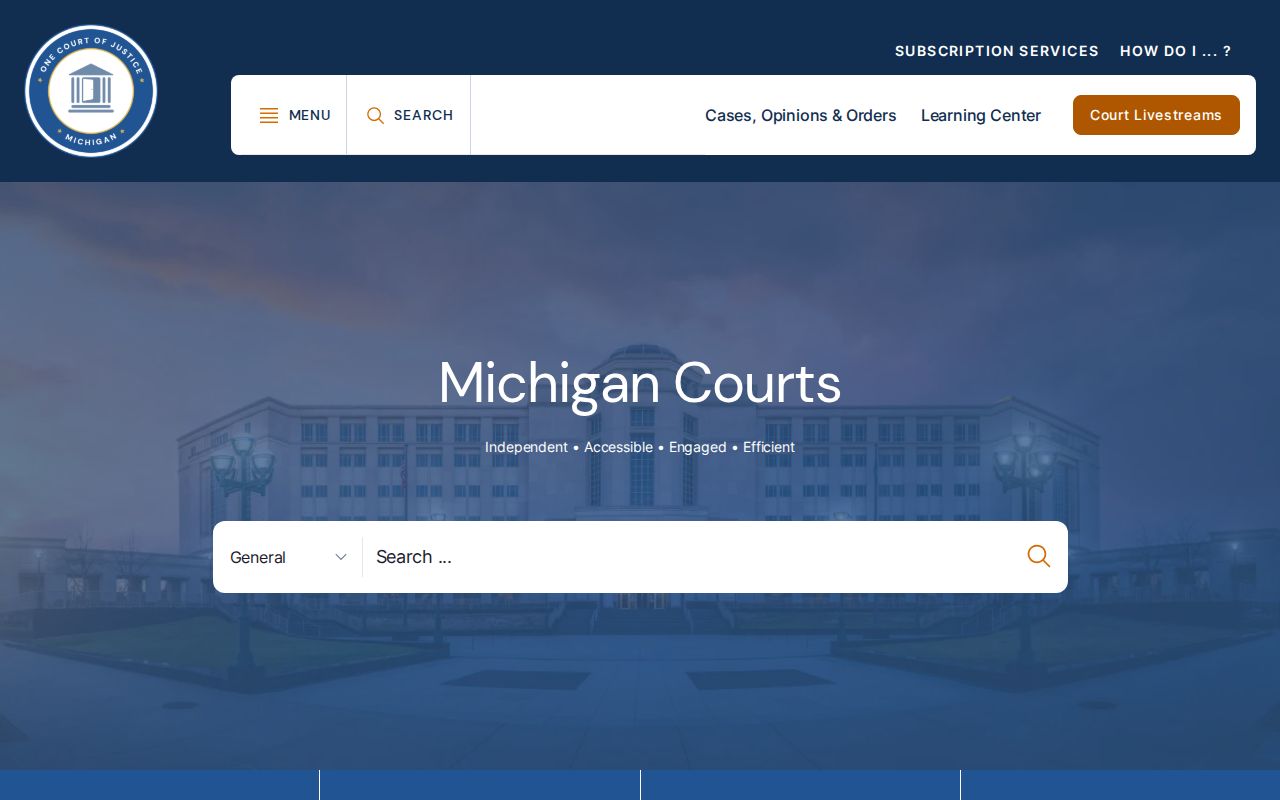
The statewide homepage links to the judiciary's administrative resources. It is not a clerk's counter for every local case. Use the directory to reach the specific Michigan Circuit, District or Probate office responsible for the record.
How Michigan Dockets Reach the State Index
Every Michigan case begins in a court with jurisdiction. That court assigns a number and logs filings and events in its case-management system, while its clerk maintains the official register and file. JIS court data may sync into MiCOURT. A court on a separate system has its own search route. An appeal opens a separate appellate case.
Docket flow: Filing at the court › Clerk review and case-system entry › Local case history and file › JIS synchronization where participating › MiCOURT public index
MiFILE sends documents to a Michigan clerk for review. So it is not the public register. Once a filing is accepted, the court system records the event. Participating JIS data may sync to search. No statewide refresh promise exists. A filing receipt, an accepted register entry and a public image are separate steps. If a result is missing, check the court and case type. Then use the County Directory to contact the clerk holding the original record.
Michigan's Incomplete MiCOURT Search
Not every Michigan court docket lives in the same system. Some circuits run their own case management instead of JIS. A 2023 Michigan SCAO report listed Wayne, Kent, Macomb, Ingham and Washtenaw among those examples. The 2026 JIS counts measure something else, so the two figures do not line up. Wayne Odyssey and Oakland Court Explorer are separate local portals. A searcher may have to visit them directly.
Results can also come back thin for other reasons. Case-type exclusions apply, and some courts filter criminal docket entries older than seven years. A blank result is not proof the file is missing. Check which Michigan court appears on the notice. Then ask that court's clerk about the record.
E-Filing Through MiFILE
MiFILE is Michigan's e-filing service. It runs on the TrueFiling platform. Authorized filers can submit an initiating document or later papers, arrange service, pay fees, or request a waiver. The clerk reviews each submission and records accepted activity in the court system. Keep in mind that MiFILE is not a public search page. The register itself comes through MiCOURT or a local service where one exists. The Michigan MiFILE / TrueFiling login shows account access, registration and available-court routes.
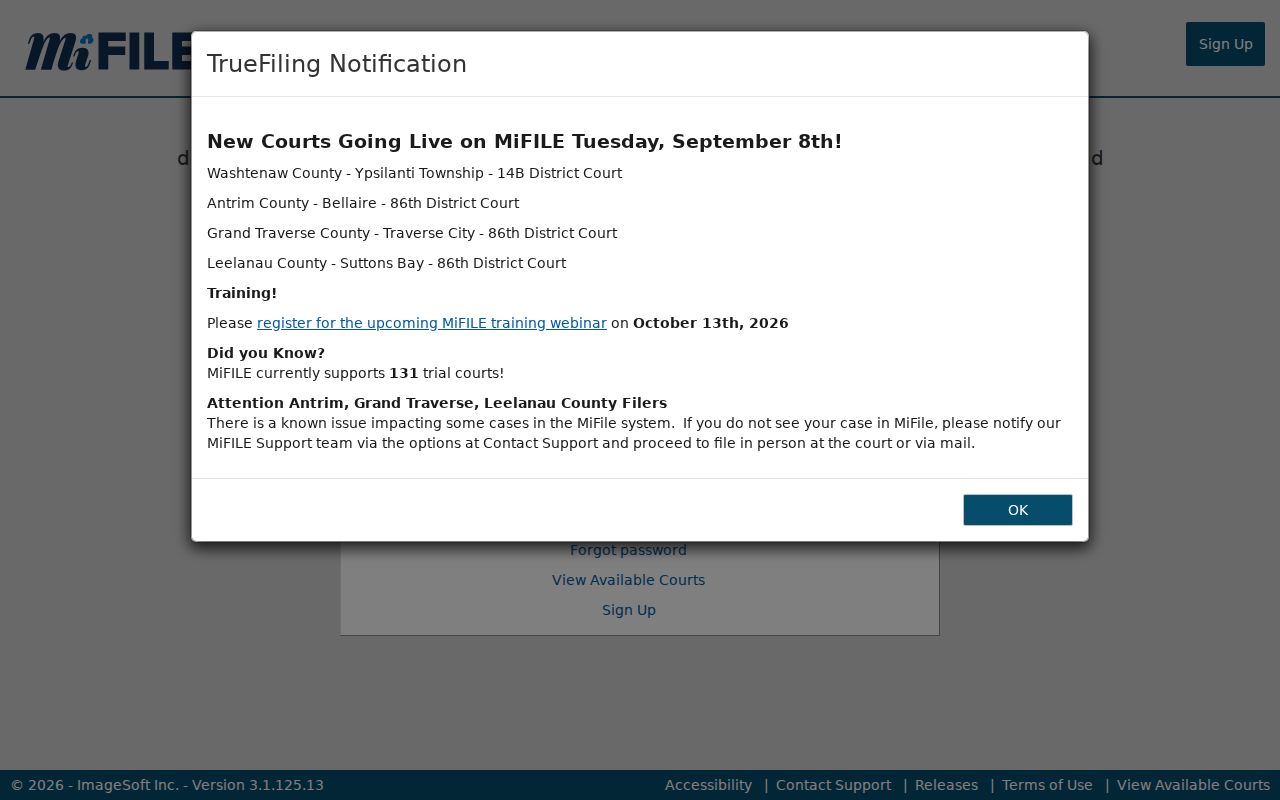
That login exists for filing participants. It does not hand the general public a full view of case documents. For case status, turn to the public case-search service. Or use the local court's own record access procedure.
Attorney e-filing became mandatory in Michigan's Supreme Court and Court of Appeals. The rule was AO 2014-23. It took effect February 1, 2020. Public appellate lookup runs through a separate Cases, Opinions & Orders route.
MiFILE Coverage in Michigan Courts
Coverage numbers need context. Michigan's March 17, 2026 matrix lists court, case type and filer eligibility, and a login notice from the same period said MiFILE supported 127 trial courts. That figure covers filing, not MiCOURT search. Separate pilots continued in Wayne, Oakland, Antrim/Grand Traverse/Leelanau, Macomb and the 20th Circuit under AO 2019-4. A platform notice also warned that some Antrim-area MiFILE cases might not show up in the filing service. That is a filing quirk rather than a public-search exclusion.
Later plans point the same direction but stop short of statewide conversion. Michigan's January 2026 concurrent-jurisdiction plans and an April 2026 electronic-service pilot each target specific courts or tasks. The pilot spans five trial-court sites. Check the MiFILE list of available Michigan courts. Read local instructions, then call the clerk to ask about acceptance and public visibility.
Michigan Portal vs County Docket
Use MiCOURT when a case sits at a participating Michigan location. It fits when you just need the public record. Switch to a local court portal or the clerk when a case does not appear, a document image is needed, or certification is required. The statewide index and the local register do different jobs. Each fills in what the other leaves out.
| Feature | Statewide portal | Local court docket / clerk |
|---|---|---|
| Coverage | Participating JIS courts and included cases | Local files subject to jurisdiction and access rules. |
| History | Index and available summary events | Official register kept by the clerk. |
| Documents | No statewide image guarantee | Local inspection or copy process. |
| Certification | Cannot certify the county file | Request from the custodian clerk. |
The Michigan Trial Court Directory tells you which court you are dealing with. From there, the County Directory routes you to local details. Confirm the court number too, since one Michigan county can run several District Court locations or share a territory with a neighboring county.
Michigan Court Administration and Reporting
SCAO is the Michigan Supreme Court's administrative office. It is not a statewide clerk for county files. MCR 8.103 assigns it rule implementation, court support and statistical reporting, while MCR 8.110 covers trial-court administration. The local clerks keep the actual case register and file.
Annual reporting is mandatory. MCR 8.103(7) and 8.110(C)(1) require Michigan courts to submit statistics, and the dashboard filters those figures by year, county, court and case type. Aggregate numbers, though, will not pull up one case or a document image. Request a court file under MCR 8.119. Judicial administrative information falls under AO 1997-10.
Michigan Court Technology and History
Michigan's court network took shape in steps. The Michigan Constitution of 1963 created a uniform judiciary. The Court of Appeals began in 1965, and District Courts started in 1969. The Circuit Court Family Division pulled much of the child and family jurisdiction together in 1996. E-filing pilots appeared by 2005. Appellate e-filing followed AO 2014-23, and MiFILE has grown in phases since 2019. Older paper files sit under local retention rules and may never have been digitized.
One more distinction matters here. The MiCOURT Calendar API reference for Michigan courts shows developer schedule filters. It is not a public calendar or a case-search interface.
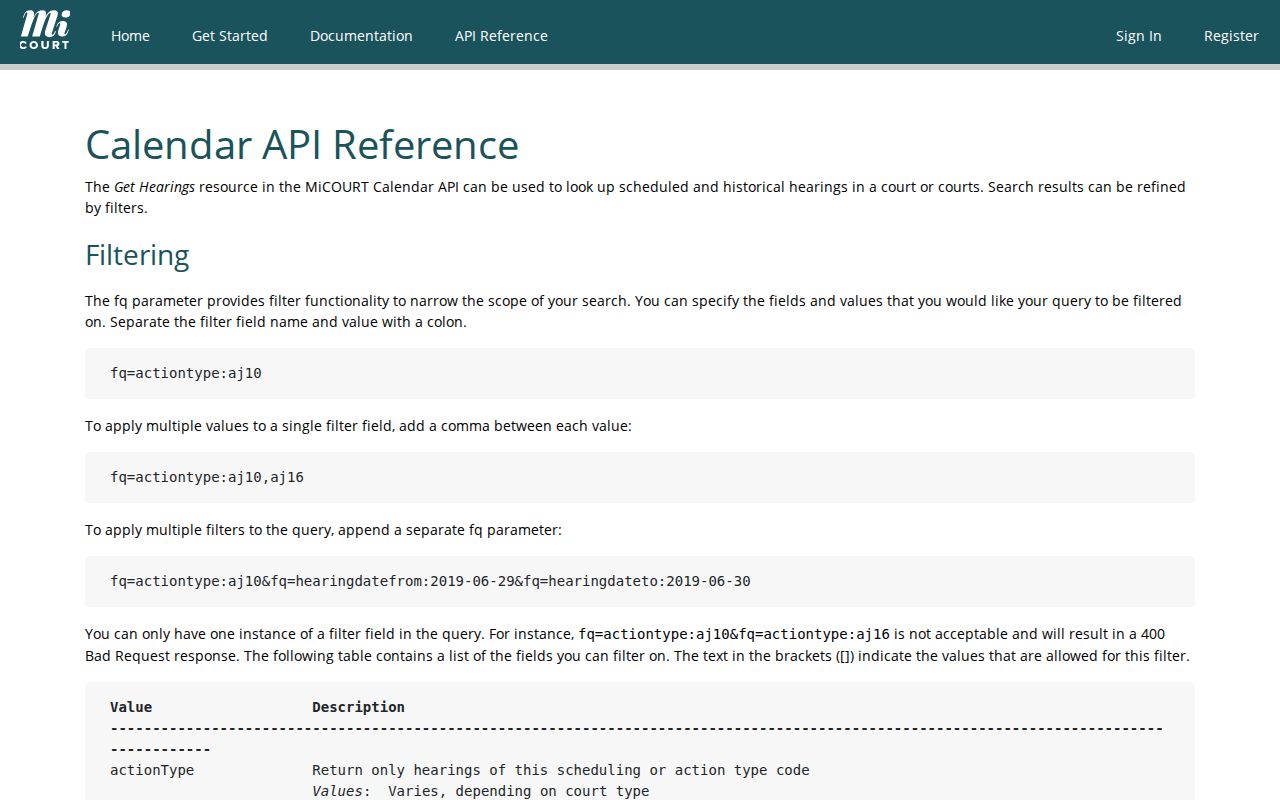
Michigan's court APIs require subscription credentials and permissions. There is no open bulk export. Local calendars hold the court-specific detail. A remote hearing still belongs to a particular court, date and case. Confirm any current setting or new filing with the court that holds the case. A filing receipt, an accepted docket event and a public image are three distinct steps.
Michigan's 1969 District Court Reorganization
Michigan's District Court system began with a statute. Public Act 154 of 1968 abolished the justice-of-the-peace and circuit-court-commissioner offices and created District Courts effective January 1, 1969, starting with 150 judges. That split still defines the layout. Circuit Court holds general jurisdiction, while District Court handles misdemeanors, preliminary examinations, traffic, civil infractions and limited civil claims.
The divide guides a Michigan record search today. Felony preliminary proceedings may sit in District Court before a bindover opens a Circuit Court file. Traffic usually lands in District or Municipal Court. An appeal creates yet another register, so verify the court on your notice and in the directory, since court territories can cross county lines.