
Searching Criminal Dockets in Michigan
Begin with the court printed on the summons, citation, or charging paper. Michigan's MiCOURT Case Search lets anyone search a participating court by name or case number. Coverage and case types vary by court, though. A blank result is not a statewide answer. A felony may open in District Court. It can then continue under a new Circuit Court case number after bindover.
Write down the court number and location before you search. Keep the case number handy if you have one. Note the exact spelling on the filing, too. Michigan's public name form requires a last name or business name. First name, middle name, and birth year work as optional narrowing fields in the documented interface. Case-number searches separate year, sequence number, and case type. Punctuation and display format vary by court, though. Treat any result as an index. It is not a substitute for the official register or a signed order.
- Identify the issuing or filing Michigan court from the citation, summons, or case papers.
- Choose that court in MiCOURT, then search by name or case number.
- Record the court, location, case type, status, and newest event shown.
- If the result is missing or brief, use the County Directory to reach the correct local court and clerk.
- Ask the clerk for the public register or a specific filing, order, or certified copy.
Michigan Criminal Search by Court
MiCOURT is the statewide public search brand, and it is not one giant criminal database. Only Judicial Information System courts that opt in appear. It shows just what those courts release publicly. The form includes a court selector plus a "Select Another Court" control. The list of courts is dynamic. One court is searched at a time. Before concluding a case does not exist, use the Michigan Trial Court Directory to verify the court number and location printed on the charging paper.
Directory links also help you separate courts. They distinguish a Circuit Court from the District Court branch that handled an arraignment or preliminary examination. A public result may list a summary, event history, status, or next hearing. Document images vary, though. MiFILE handles e-filing for supported courts. A filing receipt does not prove a criminal case is searchable there.
The Trial Court Directory's court selector and contact links confirm which court holds a criminal case.
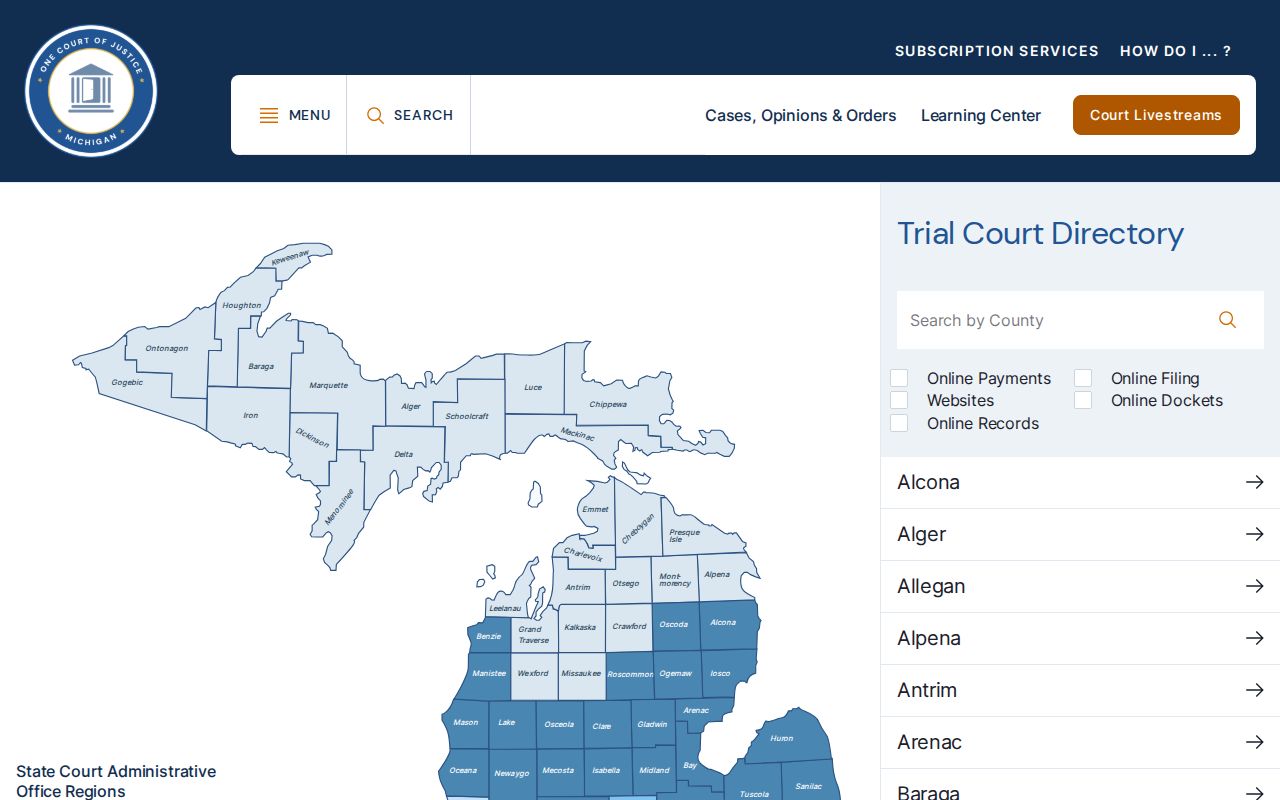
Match the court location shown there to the right Michigan register. When the public search leaves a case question open, contact that court's clerk.
What a Michigan Criminal Docket Shows
Michigan Court Rule 8.119 calls the chronological record of case activity the "case history." It is commonly labeled the Register of Actions. It lists events that were filed or issued. The case file itself holds the complaints, motions, orders, judgments, transcripts, and other papers. A docket row may name a filing without reproducing it. Public fields vary by court and case type. A case number can also keep its original number after transfer or reopening.
Read the court, location, type, filing date, status, and disposition before interpreting any entry. A criminal summary may also list the prosecutor, police agency, or judge. Charge level, attempt indicator, or next hearing may appear too. Balance and status fields are a system display. They are not a receipt or clearance certificate. Ask the clerk about any unexplained local abbreviation.
| Case Number | A Michigan case number usually combines a year, sequence, and court case-type code, such as year-sequence-FH. Punctuation and added court identifiers vary. |
|---|---|
| Charge and level | May identify the charged offense, statutory reference, degree or level, and an attempt/conspiracy/solicitation indicator. |
| Case events | Dated entries can record arraignment, preliminary examination, bindover, plea, motion, trial, sentence, warrant, or closure. |
| Hearing setting | A next-hearing date or time may appear, depending on the court; a setting is not proof that the hearing occurred. |
| Status and disposition | May show open, closed, disposed, or outcome text. A case-level status need not describe the result of every charge. |
Michigan Criminal Case-Type Codes
Michigan's published case-type codes classify the court matter. They say nothing about guilt, sentence, or the final result. A code can also signal the procedural stage. District Court's felony preliminary stage carries a different code from a Circuit Court felony trial. The official Michigan SCAO case-type list sorts the abbreviations by court level. It beats assuming one universal criminal code applies everywhere.
- FH and FC
- Circuit Court felony categories: noncapital felony and capital felony, respectively.
- FY
- District Court felony-stage or preliminary-jurisdiction category.
- SM and OM
- Statutory misdemeanor and ordinance misdemeanor categories.
- FD / FT / SD / OD
- Felony drunk driving, other felony traffic, statutory misdemeanor drunk driving, and ordinance misdemeanor drunk driving categories, respectively.
- FJ
- Juvenile waived-felony category; related juvenile records have strict public-access limits.
A criminal code describes the type of file, not its disposition. Michigan publishes no all-court public key covering every criminal outcome abbreviation. Read the event text and any signed order or judgment. A closed case is not automatically a dismissal. One charge may also end differently from another in the same case.
Stages of a Michigan Criminal Case
A Michigan criminal register reflects both the court's work and the path of the charge. Misdemeanor and ordinance cases ordinarily stay in District Court. A locally authorized municipal court may handle some matters, though. A felony usually opens with a District Court file. It covers arraignment and preliminary examination or waiver. If bound over, the Circuit Court gets a separate case number for later proceedings. The first docket may lack the trial, plea, or sentence entries a reader expects.
Read case events in date order. A preliminary-examination setting is not proof the examination took place. Look for a later event, bindover order, or other result. After transfer, search the receiving court as well as the originating District Court. An appeal adds yet another register. It may sit in Circuit Court, the Court of Appeals, or the Michigan Supreme Court. Each level records its own filings and rulings rather than extending one uninterrupted trial-court docket.
Typical felony path: District Court arraignment › preliminary examination or waiver › bindover › Circuit Court proceedings › judgment or sentence.
Michigan’s Seven-Year Criminal Filter
A handful of Michigan courts switch on a seven-year filter for public criminal-sentence searches in MiCOURT. The filter is not universal. When the filter is on, convictions older than seven years from the search date drop out of the public results. The file itself still exists. This filter is set court by court. That tells you nothing about whether an older Michigan court record has vanished. There is no statewide back-to-year date either. Retention practices, system conversions, and old paper files differ from one court to the next.
If an older case fails to show up, first confirm you have the right court. Then ask that court's clerk where the docket sits. It could be a local system, an archive, or microfilm. Set-aside cases that qualify follow their own access rules. A search filter never unlocks confidential material. Remember that a blank result proves nothing. A case can exist and still be absent from the online index. Let the clerk explain what public record remains and how to request it locally.
Where Michigan Criminal Dockets Sit
Michigan splits criminal work across several court levels. District Courts take most misdemeanors, ordinance violations, felony arraignments, and preliminary examinations. Felonies move to Circuit Court after bindover, along with higher-penalty matters. Municipal Courts hold limited local authority. Juvenile delinquency lands in the Circuit Court's Family Division under restricted access.
Custody of the paper matters too. The District Court Clerk keeps the District file. The county clerk usually acts as Circuit Court Clerk, so one felony can leave tracks in two trial-court registers. Michigan's districts and locations do not line up neatly with counties. Use the County Directory to reach the specific court and custodian named on the case papers.
| Criminal stage | Usual Michigan court | Register to check |
|---|---|---|
| Misdemeanor or ordinance case | District Court; sometimes Municipal Court under local authority | Issuing court’s case history |
| Felony arraignment or examination | District Court | Preliminary-stage file |
| Felony after bindover | Circuit Court | New Circuit Court number and history |
| Appeal | Circuit Court, Court of Appeals, or Supreme Court | Separate appellate register at each level |
When MiCOURT Misses a Michigan Criminal Case
A blank screen has several possible causes. The court you picked may be wrong. The court may skip public MiCOURT. The case type may be excluded, the record may be restricted, or the entry may not have reached the index yet. Before trying another venue, search the court named on the citation or complaint. A Michigan felony that moved after bindover can carry a Circuit Court number. Meanwhile the District Court's preliminary file sits frozen without later trial events.
Pull the court number and case type straight from the Michigan paperwork. Check the official local portal. Then phone the clerk using the Trial Court Directory contact details. The clerk can walk you through public-terminal, in-person, mail, or other request options. Procedures vary, and Michigan offers no single statewide criminal-file request form. Do not try to push past public search limits with an API or automated queries.
Appeals live elsewhere entirely. Switch to the Michigan appellate case search for those. A federal charge calls for the PACER Case Locator. Neither one substitutes for the originating Michigan trial-court register.
Sealed Criminal Dockets in Michigan
Michigan court rules, statutes, and local access procedures control what the public can see. MCR 8.119 requires a case history and public access where the rule permits it. Even so, many categories never appear in MiCOURT at all. Juvenile matters, child-protective proceedings, personal-protection-order cases, and mental-health matters stay out of ordinary public searches. A criminal docket can also be sealed or partly restricted by law or court order. Some public cases display only a limited shell while withholding names, documents, or case type.
A felony bindover can shift access between the District and Circuit files. Sealed is not the same as missing. A Michigan clerk cannot hand over material restricted by law or order, no matter who asks. Michigan FOIA does not govern judicial case files. Requests go to the court clerk under MCR 8.119 instead. Sealing demands a written motion and findings of a protected interest. The court must also look at narrower alternatives. Michigan court opinions and orders cannot be sealed under that rule.
Michigan access rules:
MCR 8.119 governs trial-court case histories, public inspection, restrictions, sealing, and local access procedures.
MCR 1.109 requires protection of specified personal identifying information in filed records.
MCR 3.903 defines family and juvenile terms relevant to confidentiality and access.
MCL 780.621 et seq. addresses setting aside convictions and affects public visibility for eligible records.
Finding a Michigan Criminal Judgment
A Michigan register entry may identify a judgment of sentence without linking the signed document. Note the court, case number, charge, and filing date, then ask whether the judgment is online, available at a public terminal, or requires a copy request. Inspection is free under MCR 8.119(J); reproduction, certification, transcript work, and archives are separate.
Michigan local rules govern whether the clerk accepts a request in person, by mail, or by email. Ask for current costs; MCL 600.2546 sets a default $10 plus $1 per page for certified Circuit, District, or Probate copies where no special fee applies. Reach the right clerk through the County Directory.